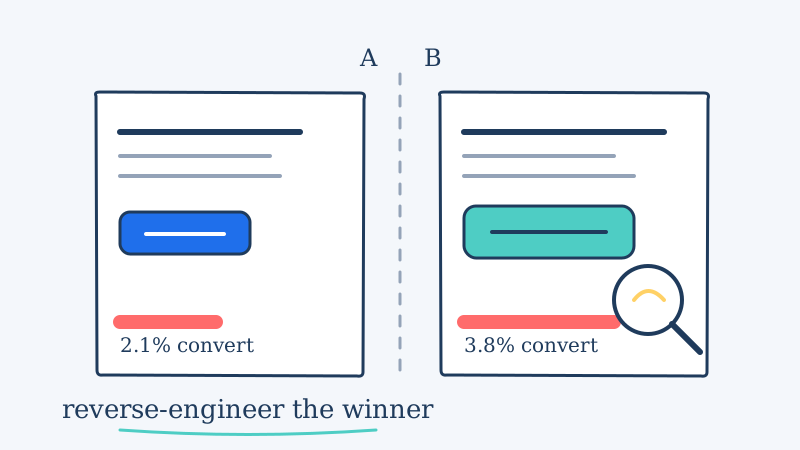
Every time a competitor spins up an A/B test on their homepage or a key landing page, they are spending real traffic and real money to answer a question you care about too: what actually makes this audience convert. When the test ends, they roll out the winner. If you were watching, you get the punchline without paying for the experiment.
Most teams never look. They screenshot a competitor’s homepage once a quarter and call it competitive research. But the interesting movement happens between those snapshots, in the weeks when a competitor is quietly cycling through headline variants, swapping call-to-action copy, and reshuffling the order of their proof points. This post covers how to detect those experiments while they run, how to tell a test from a permanent change, and how to turn the eventual winner into a positioning and conversion advantage for your own funnel.
Why competitor experiments are worth watching
A landing page A/B test is one of the most honest signals a company emits. Marketing copy on a static page tells you what a competitor wants to believe about themselves. A live experiment tells you what they are unsure about and are actively trying to resolve with data. Those are two very different things.
When you catch a competitor testing, you learn three things at once:
- Where they think their funnel is weak. Teams do not run experiments on pages they are happy with. A burst of testing on the pricing page means pricing conversion is a live concern.
- Which hypotheses they are betting on. The variants themselves are a list of their current beliefs about the market, spelled out in headline and button copy.
- What ultimately won. When the test resolves and one variant becomes permanent, you have a validated conversion lesson you did not have to fund.
This is the same logic behind watching a competitor’s pricing page changes for positioning shifts, except experiments give you the earlier, messier signal: the questions before the answers.
How to tell a page is being A/B tested
You cannot see a competitor’s experimentation dashboard, but tests leak in ways you can observe from the outside. Here is what to look for.
The page changes when you did not expect it to
The most reliable tell is variance. Load a competitor’s landing page in a fresh incognito window, then again from a different device or network, and compare. If the hero headline, the CTA text, or the section order differs between two clean sessions, you are almost certainly being bucketed into different variants of a running test. A single permanent redesign looks the same to everyone. A test does not.
Doing this by hand is tedious and easy to forget, which is exactly why continuous change monitoring matters. A tool like CAM can watch a specific URL and alert you the moment the rendered content shifts, so you are comparing captures on a schedule instead of relying on memory. That turns “I think their homepage looks different” into a timestamped record of every variant that appeared.
Experimentation scripts in the page source
Many teams run tests through client-side tools, and those tools announce themselves in the page. View source or open the network tab and look for the tell-tale requests and globals: Optimizely, VWO, Google Optimize successors, Convert, AB Tasty, and similar platforms all inject recognizable scripts and cookies. The presence of one of these does not prove a test is live on the page you are looking at, but it tells you the competitor has the machinery in place and uses it. Combine that with observed content variance and you have strong confirmation.
Cookie and query-string fingerprints
Experiment frameworks usually set a bucketing cookie so a returning visitor keeps seeing the same variant. If you clear cookies and the page flips, that is a test. Some teams also expose variant identifiers in the URL or in data attributes on key elements. Reading those attributes across sessions lets you count how many variants are in flight, which hints at how ambitious the experiment is.
Reading the experiment while it runs
Detecting a test is step one. The intelligence comes from decoding what is actually being tested.
Catalog the variants
Every time you observe a new variant, log it: the headline, the subhead, the primary CTA copy, the hero image, and anything structural like a reordered feature list or a new social-proof block. Over a week or two you will accumulate the full set of variants the competitor is cycling through. That set is a direct readout of their hypotheses. If three of four variants lead with a security message, the competitor believes trust is their conversion bottleneck right now, which is a gift if you sell against them.
Note what stays fixed
What a competitor refuses to test is as telling as what they change. If the price never varies across any variant but the framing around it does, they have decided the number is settled and only the story needs work. If the core value proposition holds steady while everything below it churns, that headline is their anchor. Fixed elements are the beliefs they are no longer questioning.
Watch the cadence
A short, intense burst of variants that resolves within two weeks is a focused optimization sprint. A page that keeps shifting for months is a team that either cannot find a winner or is running a continuous optimization program. Both are useful to know. You can track this rhythm the same way you would track content strategy and positioning shifts: it is the tempo of the changes, not any single change, that reveals intent.
Reading the result after the test ends
The highest-value moment is when the experiment stops. When variance disappears and one version becomes what everyone sees, the competitor has picked a winner, and you now know which message beat the others in a real market test.
Capture the final state carefully and compare it to your log of variants. The winner tells you what resonated with an audience you likely share. If a competitor tested five headlines and the one that survived leads with time-to-value rather than feature breadth, that is a validated insight about buyer psychology in your category. You can adopt the lesson, sharpen a counter-position, or deliberately zag where they zigged, but only if you were watching closely enough to know which variant actually won.
Keep a simple record for each experiment you observe:
- The page and the date range the test ran
- Every variant you captured, with the specific element that changed
- The final rolled-out version
- Your read on what hypothesis won and why it matters to your funnel
Over a few quarters this record becomes a conversion playbook assembled from your competitors’ budgets rather than your own.
Turning the signal into action
Watching is only valuable if it changes what you do. A few ways to put competitor experiment intelligence to work:
Sharpen your own landing pages. When a competitor’s test resolves on a clear winner, you have a low-risk hypothesis to try on your own page. You are not copying their design, you are borrowing a validated direction and testing whether it holds for your audience.
Arm the sales team. If a competitor is visibly testing trust and security messaging, that is a hint they are hearing objections there. Feed that to sales as a wedge. This pairs naturally with monitoring their trust and security pages for enterprise moves, so you see both the experiment and the permanent commitments.
Time your outreach. A competitor overhauling their conversion funnel is often preparing for a bigger push: a launch, a raise, or a repositioning. That is a good moment to accelerate your own outbound. Clean, deliverable prospect lists matter here, and running your target accounts through an email validation layer like Scrubby before a campaign keeps your bounce rate low when timing counts. If your play is booking demos against a distracted competitor, calendar-first outreach tools like Kali help you turn that window into meetings.
Feed it into your broader monitoring picture. Landing page experiments are one stream among many. The teams that win at competitive intelligence combine them with pricing, hiring, and product signals into a single timeline. Continuous website monitoring with CAM is what makes that timeline possible, because it catches the changes the moment they happen instead of the next time someone remembers to check.
A lightweight monitoring routine
You do not need a research team to do this well. A workable routine looks like this:
- Pick the five to ten competitor pages that matter most: homepage, pricing, top product pages, and any high-intent landing pages you can find in their ads.
- Put each of those URLs under continuous change monitoring so you get alerted on any content shift rather than checking manually.
- When an alert fires, load the page in a couple of clean sessions to check for variance, and glance at the source for experimentation scripts.
- Log every variant you see in a shared doc, and mark the date the test appears to resolve.
- Once a month, review the resolved experiments and pull out the conversion lessons worth testing on your own funnel.
That is the entire loop. The competitors spend the traffic and the budget. You keep the record and inherit the conclusions.
The takeaway
A competitor’s A/B tests are a public, ongoing admission of what they are unsure about and, eventually, what they proved. Snapshotting a homepage once a quarter misses all of it. Watching the pages continuously, cataloging the variants, and reading the winner turns their experimentation spend into your conversion strategy. Set up monitoring on the handful of pages that matter, and let your competitors run the experiments you get to learn from.