Ask a competitive intelligence lead which competitors they track and you usually get one of two answers. The first is a number that is far too small, typically two, because those are the only names leadership talks about. The second is a number that is far too large, typically thirty or more, usually inherited from a spreadsheet nobody has pruned since the Series A.
Both answers produce the same outcome, which is a program that cannot tell you anything useful on the day you need it. The short list misses the competitor that started showing up in losses last quarter. The long list technically covers that competitor, in the sense that its name appears in a row, but the coverage is one inch deep across thirty names and nobody notices the one that matters.
The choice of what to monitor is upstream of every other decision in competitive intelligence. Get it wrong and better tooling does not save you, because you will be running excellent surveillance on the wrong companies. This guide covers how to assemble the set from evidence rather than opinion, how to tier it so monitoring depth matches commercial relevance, and what should trigger a name moving between tiers.
Why the long list quietly fails
A thirty-name tracking list is not thirty times more informative than a three-name list. It is usually less informative, for three reasons that compound.
Attention does not scale with the list. The human reviewing competitor signals has a fixed budget, maybe an hour a week. Spread that across thirty companies and each one gets two minutes, which is enough to skim a headline and not enough to notice that a competitor’s pricing page quietly lost its entry tier. Depth is what produces insight, and depth is the first thing a long list destroys.
Noise crowds out signal in the digest. When your weekly roundup contains forty items, readers stop reading it. This is the most common death spiral in competitive intelligence: the program responds to low engagement by adding more coverage, which lowers engagement further. If you are already fighting this, the structure of the digest matters as much as its contents, which is something we covered in detail in our guide to running a competitive intelligence newsletter your sales team actually reads.
Nobody owns a name on a long list. Three competitors can have three named owners. Thirty cannot, so they end up collectively owned, which means unowned. Unowned names get monitored by automation that nobody reads.
The fix is not to cut the list to three and accept blind spots. It is to accept that different competitors deserve different depth, and to make that explicit rather than accidental.
Build the set from evidence, not from the org chart
The single most common sourcing error is asking executives to name the competitors. You will get the companies that are most salient, which correlates with who presents at the same conferences and who the CEO argues with on LinkedIn, not with who is actually taking your revenue.
Use four evidence sources instead, in roughly this order of reliability.
1. Lost-deal reasons from the last four quarters
This is your ground truth, and it is the only source that directly measures revenue impact. Pull every closed-lost opportunity for the trailing twelve months and count the competitor named in the loss reason.
Two cautions. First, the field is usually dirty: reps pick whatever option closes the record fastest, and “price” frequently means “a competitor was cheaper” without naming them. Second, count by revenue at risk, not by deal count. Ten lost deals worth five thousand dollars each matter less than two lost deals worth a hundred thousand, and a raw count will rank them backwards.
If your loss-reason data is too thin to rank anything, that is itself the finding, and fixing the capture is a higher-leverage project than buying a monitoring tool. Our walkthrough on how to build a win-loss analysis program from competitor monitoring data covers how to make that data trustworthy enough to tier against.
2. What your reps hear on live calls
Loss reasons tell you who beat you. Call mentions tell you who is in the room, which includes competitors that prospects evaluated and discarded before you ever saw a deal. That second group is your early-warning population.
Search your call recordings for competitor names and track mention frequency over time. The derivative matters more than the level: a competitor mentioned in four percent of calls this quarter versus one percent two quarters ago is a more important signal than one sitting steadily at twelve percent. Steady-state competitors are known quantities. Accelerating ones are the ones you have not built a response for yet.
3. Search and review-site overlap
Pull the companies that rank alongside you for your highest-intent commercial keywords, and the companies your category’s review-site visitors compare you against. Review platforms publish comparison pairings, and those pairings reflect what buyers actually weigh rather than what analysts group together.
Treat this source as directional. It captures competitors for attention, which overlaps with but is not identical to competitors for budget. A content-marketing machine with no sales team can outrank you everywhere and never appear in a single loss.
4. Who your prospects are already connecting with
The first three sources are all retrospective. They tell you about deals that already closed and calls that already happened, which means the competitive set they produce is a picture of the last four quarters rather than the current one.
The forward-looking version of this question is which competitors are working your accounts right now. When a competitor’s sales rep connects with someone at a company in your target market, that is observable, and it tells you the competitor is active in that account before any of it reaches your pipeline. This is the signal CAM is built around: it tracks the new LinkedIn connections that your competitors’ sales reps make, enriches each one with job title, company, industry, size and location, and scores it against your ICP so the names that match your market surface first.
For set selection specifically, the useful output is the aggregate rather than the individual lead. If one competitor’s reps are generating sustained new connection volume inside your ICP and another’s are quiet in your segment, you have evidence about where to spend monitoring depth that no retrospective source can give you. The overview for sales teams walks through how that data is structured.
Sort the set into three tiers
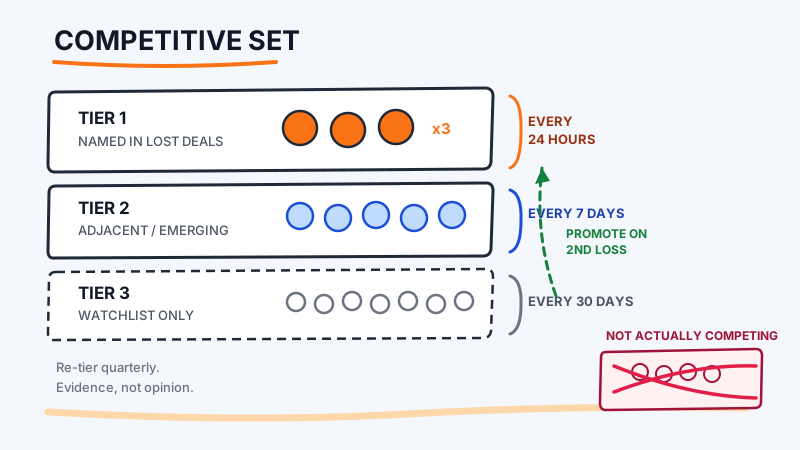
Once you have a ranked list, stop treating it as a list. Tiers exist so that monitoring depth, review cadence, and ownership can differ by commercial relevance.
Tier 1: competitors that cost you revenue
Entry criterion: the competitor appears in closed-lost reasons for material deals, repeatedly, or is displacing you inside existing accounts.
These get the deepest coverage you are capable of. Every Tier 1 competitor should have a named human owner, a maintained battlecard, and monitoring on the signal classes that change sales conversations: pricing, packaging, positioning, enterprise readiness, and sales motion. Changes here should reach your reps within a day, because a pricing change you learn about in six weeks has already cost you deals.
Tier 2: adjacent and accelerating
Entry criterion: the competitor is growing in call mentions, winning in a segment next to yours, or expanding toward your market from an adjacent category.
Tier 2 is where most programs are weakest, and it is where the surprises come from. These companies are not beating you consistently yet, so they do not justify Tier 1 depth, but the whole point of monitoring them is to notice the moment they start to. Monitor strategic direction rather than tactical detail: hiring patterns, roadmap and changelog movement, funding, and positioning shifts. Reviewing monthly is usually enough.
Hiring is the highest-yield Tier 2 signal class, because headcount commitments precede product and go-to-market moves by a quarter or more, which is exactly the lead time you want for a company that is not yet hurting you. We covered the mechanics of reading those signals in monitoring competitor hiring patterns to predict product moves.
Tier 3: watchlist
Entry criterion: plausibly competitive, no current deal evidence.
Tier 3 exists to stop Tier 1 and Tier 2 from bloating. Everything that someone insists must be tracked, but which has no evidence behind it, goes here. The honest description of Tier 3 is that it is low-cost automated coverage with no dedicated human attention. Check it quarterly, and expect most of these names to produce nothing. That is the correct outcome, not a failure.
Keeping Tier 3 cheap is what makes it viable, which means it should be fed by low-maintenance monitoring on a slow cadence rather than by anyone’s calendar.
How many names per tier
Rough starting ratios that hold up across most B2B teams:
| Tier | Count | Review cadence | Owner |
|---|---|---|---|
| Tier 1 | 3 to 5 | Daily signals, weekly review | One named person per competitor |
| Tier 2 | 5 to 10 | Monthly review | One person for the whole tier |
| Tier 3 | 10 to 20 | Quarterly skim | Automated, no dedicated owner |
If Tier 1 has more than five names, your deal evidence is probably not ranked by revenue, because very few companies genuinely lose material revenue to six or more competitors. If Tier 1 has one name, you are likely missing a second-order competitor that your reps have stopped bothering to report.
Cadence is the practical lever that makes tiering real. A tiered set only works if the underlying monitoring can actually run at different speeds, which is why per-competitor cadence is worth insisting on in whatever tooling you use. CAM, for instance, lets you set the monitoring cadence per profile (every 24 hours, 7 days or 30 days), so Tier 1 reps can be checked daily while Tier 3 sits on a monthly cycle without generating noise or extra cost. The LinkedIn connection tracking page covers how cadence is configured per profile.
Make re-tiering automatic, not political
A tiered set decays. Competitors fade, new ones arrive, and the tiering that was correct a year ago is now describing a market that has moved. The failure mode is that re-tiering becomes a debate, and debates default to the status quo.
Avoid that by writing the triggers down in advance, so promotion is a mechanical consequence of evidence rather than an argument someone has to win.
| Trigger | Action |
|---|---|
| Named in two or more material losses in a quarter | Promote to Tier 1 |
| Call mentions triple quarter over quarter | Promote to Tier 2 |
| Raises a large round or announces a move into your core segment | Promote at least one tier |
| Zero loss appearances and flat mentions for two quarters | Demote one tier |
| Acquired, sunset, or pivoted out of your market | Drop entirely, with a note on why |
Run the review quarterly, time-boxed to an hour, with the trigger table open. The discipline that matters most is demotion. Programs are good at adding names and almost universally bad at removing them, which is how a focused set of eight becomes an unreadable thirty inside two years.
Record the reason for every tier change. A year later, the log is the most useful competitive artifact you own, because it shows the trajectory of the market rather than a snapshot of it.
Four mistakes worth naming
Tracking the market leader you never actually meet. The largest company in your category may not be your competitor. If they have never appeared in a loss and never come up on calls, they belong in Tier 3 regardless of how often leadership mentions them.
Treating all signals as equally urgent within a tier. Tiering the competitor is only half the job. A pricing page change and a new blog post from the same Tier 1 competitor do not warrant the same response speed.
Letting the set be defined by what your tool happens to cover. This is backwards, and surprisingly common. Decide the set from deal evidence, then ask whether your tooling covers it. If you are evaluating options, our rundown on how to evaluate competitor intelligence tools is organized around coverage questions rather than feature lists.
Keeping the set private. If reps cannot see which competitors are tiered where, they will not report the signals that drive re-tiering, and your evidence pipeline dries up.
A worked example
A mid-market B2B software company with roughly forty million dollars in revenue pulls four quarters of closed-lost data and finds competitor names in sixty-one losses. Two competitors account for seventy percent of lost revenue, so both go to Tier 1 with named owners and daily signal monitoring.
Call-mention analysis surfaces four more names, one of which has gone from two mentions to nineteen in two quarters. All four go to Tier 2, and the accelerating one gets flagged for promotion review at the next quarterly cycle rather than waiting for it to show up in losses.
Search overlap adds eleven companies, nine of which have never appeared in a loss or a call. Those nine go to Tier 3 on a thirty-day cadence. Two of the eleven are content-only players with no sales motion in the segment, so they are dropped with a note.
Total: two Tier 1, four Tier 2, nine Tier 3. Fifteen names, down from the inherited spreadsheet’s thirty-four, with more depth on the two that actually matter and a written trigger for what would change the structure.
Start with the losses
If you do one thing from this guide, pull your last four quarters of closed-lost reasons and rank the competitor names by revenue at risk rather than by deal count. That single exercise reorders most competitive sets immediately, and it usually reveals both a name that has been over-monitored for a year and a name nobody has been watching at all.
Then decide the depth each tier gets before you decide the tooling, and make sure whatever you use can run at different speeds for different names. For the forward-looking half of the picture, which competitors are working your accounts right now rather than which ones beat you last year, CAM tracks competitor reps’ new LinkedIn connections on the cadence you set per profile and scores each new contact against your ICP. Teams that want to pull that data into their own models or agents can do it through the public REST API and remote MCP server.