Most competitive intelligence programs do not fail at collection. They fail at distribution.
The collection part is genuinely easier than it has ever been. You can watch pricing pages, changelogs, job postings, review sites, and SEC filings on a schedule, and a decent monitoring setup will surface more competitor movement in a week than a human analyst would have found in a month five years ago. The hard part is that none of it reaches the person in a live deal who needs it.
The usual response is a wiki. Someone builds a competitor space in Confluence or Notion, fills it with battlecards, and announces it in a channel. Three weeks later the pages are stale, nobody has opened them since onboarding, and a rep loses a deal to an objection that was documented in month one.
The fix is not a better wiki. Wikis are pull, and reps in the middle of a quarter do not pull. The fix is push: a short, regular, opinionated digest that lands in front of the sales team whether or not they went looking for it.
This post is the format. Not the theory of why CI matters, but the actual structure of a weekly email, what goes in each section, how to write an entry a rep can use in a call that afternoon, and how to tell if anyone is reading it.
Why a newsletter beats a dashboard for sales teams
Dashboards are excellent for analysts and nearly useless for quota carriers. The difference is in who is expected to interpret.
A dashboard presents state and asks the viewer to notice what changed and decide what it means. That is reasonable work for someone whose job is competitive intelligence. It is unreasonable for an account executive with eleven open opportunities who has four minutes between calls. A dashboard full of competitor signals is a to-do list of inference, and inference is exactly the labor your CI function exists to absorb.
A newsletter inverts it. Every entry arrives pre-interpreted: here is what happened, here is what it means, here is what you say. The rep does no analysis. They read a sentence and use it.
The second advantage is temporal. A wiki page has no date, so it reads as permanently true, which is how battlecards rot. A dated digest is honest about being a snapshot. Entries are allowed to be provisional. You can write “their pricing page changed on Tuesday and we do not yet know whether this is a test or a permanent move” in a newsletter. You cannot write that on a battlecard without undermining the whole document.
None of this means you should not have a dashboard. Build one for yourself, as the CI owner, and use it as the raw input you write from. If you want the mechanics of that layer, our walkthrough on how to build a competitive intelligence dashboard in 30 minutes covers it. The digest is what you produce from the dashboard, not a replacement for it.
The format
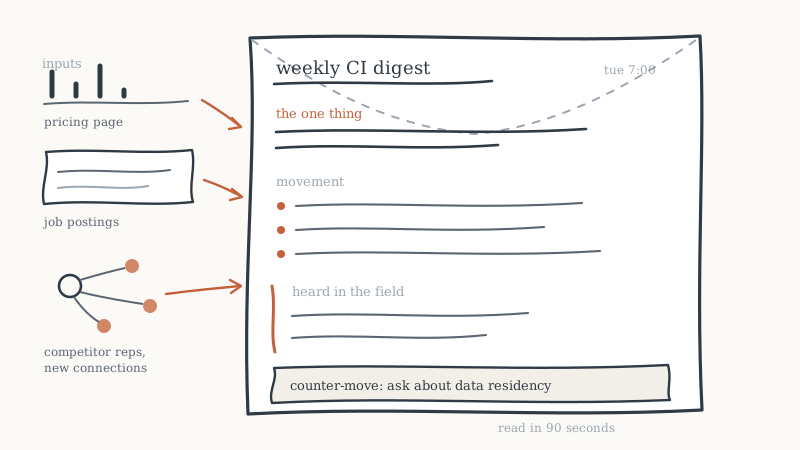
Five sections. Fixed order. Same structure every week, because predictable structure is what lets a reader skim to the part that matters to them.
1. The one thing (two sentences, maximum)
The single most important competitive development of the week, stated plainly, with the implication attached.
Not a list. One item. If you write three, your reader prioritizes for you and does so badly. The discipline of choosing is most of the value you add.
Example:
The one thing: Competitor A removed the per-seat tier from their pricing page on Monday and now quotes platform pricing only. If you are in a deal under twenty seats, you now have a price-point advantage you did not have last week. Lead with it.
Two sentences. A rep can read that on a phone in the parking lot before a call and be meaningfully better prepared.
2. Movement (three to six bullets)
Discrete, dated events. Each bullet is one competitor, one change, one sentence of meaning.
The rule here is that nothing enters this section without a date and a source. “They seem to be moving upmarket” is not an entry. “Their careers page added four enterprise AE roles on October 2, all requiring experience selling to regulated industries” is an entry. The first is a vibe. The second is a fact a rep can repeat to a prospect without risk.
Keep each bullet to a single line plus a short consequence:
- Competitor B published a SOC 2 Type II report (Sept 29). The security-posture objection we have used in financial services deals is now weaker. Stop leading with it; pivot to data residency, where they still have no story.
- Competitor C quietly removed their Salesforce integration page (Oct 1, confirmed via sitemap diff). Worth probing in any deal where they are positioning against us on ecosystem depth.
What belongs: pricing changes, packaging changes, published roadmap or changelog items, leadership changes, funding events, new or removed integrations, security and compliance milestones, hiring patterns that imply direction, review-site shifts large enough to matter.
What does not belong: their blog posts, their social media activity, their webinar titles, awards they gave themselves. These are not nothing, but they are noise at a weekly cadence, and padding the section with them teaches your reader that the section is paddable.
3. Heard in the field (two to four quotes)
Verbatim lines from prospects, collected from calls that week, about competitors.
This is the section that earns the newsletter its readership, and it is the one most CI programs skip because it requires asking other people for things. Do it anyway. Pull from call recordings, deal notes, and a dedicated channel where reps drop competitive quotes.
Attribute by segment, not by name:
- Mid-market prospect, evaluating us against Competitor A: “Their implementation quote came back at six weeks. Is that normal?”
- Enterprise prospect, incumbent is Competitor B: “We are already paying for it, we just cannot get anyone internally to use it.”
Two things happen when you run this section. Reps see their own contributions printed, so they keep contributing, and the whole team learns the actual language buyers use about competitors rather than the language your marketing team imagines they use. That second effect quietly improves discovery questions across the org.
4. Counter-move (one play)
One concrete, tested response to something in the digest. A specific question to ask, a specific slide to use, a specific reframe.
Write it as a script, not as advice:
Counter-move: When a prospect raises Competitor B’s new SOC 2 report, do not argue the certification. Ask: “Where does your data sit at rest, and do you need it in region?” Their current architecture is single-region US. In any deal with EU data obligations that question ends the comparison.
The reason this section is one play and not five is the same reason section one is one thing. A rep will remember one new move per week. They will remember zero out of five.
5. Watching (one or two lines)
Open questions. What you expect to resolve soon and are not yet calling.
Watching: Competitor A has a job posting for a “Director of Partnerships, Channel” open since Sept 18. If they are building a reseller motion it changes how they show up in our mid-market deals in the second half of next year. No action yet.
This section makes the digest feel like intelligence rather than reporting, and it gives you somewhere honest to put signals that are real but not yet actionable, instead of inflating them into section two.
How to write an entry a rep can actually use
Every entry answers three questions, in this order: what happened, what it means for us, what do I do. Most CI writing answers the first, gestures at the second, and skips the third entirely.
Date everything. An undated entry cannot be aged out, so it lives forever and eventually becomes wrong.
Cite the source. Link the pricing page, the changelog entry, the filing, the job posting. Reps occasionally need to verify something mid-deal, and more importantly, a cited entry is one a skeptical sales leader can check. Uncited CI gets ignored the first time it is wrong.
Separate observation from inference, in the sentence. “Their pricing page now shows platform-only pricing” is observation. “They are moving upmarket” is inference. Write both, marked: “Observation: X. Our read: Y.” When the read turns out to be wrong, the observation is still good, and your credibility survives.
Write the words. Not “position against their implementation timeline” but the literal sentence a rep should say. The gap between a recommendation and a script is where enablement content goes to die.
Kill the preamble. No “as you may have seen,” no “in this week’s edition,” no restating the purpose of the newsletter. Open with the content.
Cadence, length, and channel
Weekly, same day, same time. Tuesday or Wednesday morning works best in practice. Monday competes with pipeline review and inbox triage, Friday gets read by nobody. The specific day matters far less than never moving it.
Under 500 words. This is the constraint that makes everything else work. A digest you can read in ninety seconds gets read. One that takes eight minutes gets saved for later, and later does not come.
Email plus Slack, not one or the other. Post the full digest in a channel for discoverability and reaction, and send the same content by email so it reaches the people who live in their inbox. Do not link from Slack to a doc. Every click you add costs you a third of your readers.
One owner, named. The digest should come from a person, not from an alias. Named authorship raises quality and gives reps someone to reply to, and replies are where your best raw material comes from.
The input problem, and where most digests run dry
The format above is easy to maintain for three weeks. The reason most internal CI newsletters die in month two is not discipline, it is supply. If your only inputs are public web surfaces, some weeks there is genuinely nothing. A pricing page did not change, nobody published a changelog, no funding was announced. You either skip a week (which breaks the habit you spent two months building) or you pad with their blog posts (which teaches readers the digest is filler).
The structural fix is to add an input stream that produces signal every week by construction. Public web monitoring is event-driven, so it is lumpy by nature. Competitor sales activity is continuous, because their reps are prospecting every single day whether or not their marketing team shipped anything.
This is the gap CAM was built for. CAM continuously monitors the new LinkedIn connections your competitors’ sales reps make, enriches each one with job title, company, industry and location data, scores it against your ICP, and delivers a ranked lead list every week plus real-time alerts. For a weekly digest that is close to ideal timing: a fresh set of accounts your competitors’ reps just started working, arriving on the same cadence you publish on. If you want to see what gets captured and how, the LinkedIn connection tracking breakdown walks through the mechanics, and because connection monitoring syncs into HubSpot, Salesforce, or Clay, the accounts you name in the digest are already in the tool your reps work out of.
Practically, it gives you a sixth section some weeks:
In play this week: Competitor A’s enterprise reps opened connections at four accounts in our ICP, three in logistics. Two are already in our CRM as closed-lost from last year. Owners have been tagged.
That entry does something no other CI content does: it names accounts. An account name in a digest is the one thing guaranteed to make a rep read to the bottom.
Measuring whether it works
Open rate is a vanity metric for internal email. Three signals tell you more.
Reply volume. A digest that gets replies is a digest people read. Track replies per issue. If it goes to zero for three consecutive weeks, your content has drifted into reporting.
Quote contribution. Count how many distinct reps submitted a field quote this month. This is the health metric for the whole program, because a CI function with no inbound from sales is operating blind regardless of how good its external monitoring is.
Counter-move adoption. Pick a play you published and check call recordings or deal notes for the language. If three reps are using it within two weeks, the format is working. If none are, the play was too abstract and you should rewrite it as a script.
Do not try to attribute revenue to the newsletter. You will fail, the exercise will consume weeks, and no sales leader actually requires it. What they require is reps saying the newsletter is useful, unprompted, in a pipeline review. That is the real metric and you will know when you have it.
The takeaway
A competitive intelligence program is only worth what reaches the person in the deal. Collection is solved; distribution is not. A dashboard asks your sales team to interpret, which is the part they have no time for and you were hired to do.
Push a short weekly digest instead. One headline development. A handful of dated, sourced events with the implication attached. Real quotes from real calls. One scripted counter-move. One open question you are watching. Under 500 words, same day every week, from a named human.
Then solve the supply problem before it kills the habit, by pairing event-driven public monitoring with a continuous view of what your competitors’ sales teams are doing right now. The weeks where nothing is published are not weeks where nothing is happening. They are weeks where the activity moved somewhere your web monitoring cannot see.