Most competitive intelligence programs treat review sites as a one-time research task. Someone reads the competitor’s Trustpilot page once during a bake-off, screenshots a couple of angry quotes for a battlecard, and moves on. Then the page keeps updating, and nobody is watching.
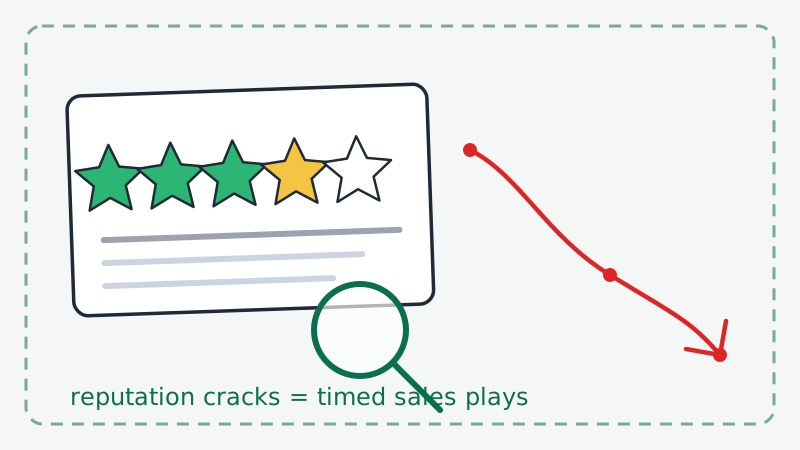
That is a missed opportunity. Trustpilot is one of the few places where a competitor’s unhappiest customers announce themselves in public, with a date attached. A rating that slips from 4.2 to 3.6 over six weeks is not a static fact. It is a wave of frustrated buyers, each one a named account that just told the internet they are unhappy. If you catch that wave while it is cresting, you get to the prospect while they are actively looking for a way out.
This post covers why Trustpilot is a buying signal, exactly which patterns to monitor, and how to build a system that turns a review spike into pipeline instead of a screenshot in a slide deck.
Why Trustpilot is different from other review sites
G2, Capterra, and TrustRadius are gated behind a B2B software buying mindset. Reviewers tend to be evaluators who were nudged by a vendor incentive, and the language is measured. Trustpilot is looser and more emotional. People land there when something has gone wrong: a billing surprise, a support ticket that went nowhere, a renewal they felt trapped in. The reviews read like complaints because that is often what they are.
That emotional rawness is exactly what makes Trustpilot useful for sales timing. A one-star Trustpilot review is rarely about a missing feature. It is about a broken promise, and a broken promise is the moment a customer becomes willing to switch. The reviewer has already done the hardest part of your job for you: they have decided the status quo is unacceptable.
Trustpilot also surfaces a different segment than the B2B review sites. You will see mid-market and SMB customers, procurement contacts, and end users who never show up on G2. If your competitor sells across segments, Trustpilot is often the only public place their long tail of unhappy accounts is visible.
The five signals worth monitoring
Not every review matters. The goal is to filter noise and watch for the patterns that predict a switchable account.
1. Rating velocity, not the absolute score
A competitor sitting at a stable 4.0 for two years tells you little. A competitor dropping from 4.4 to 3.7 in a quarter tells you something is actively breaking. Track the direction and the speed of change, not just the current number. Velocity is the signal. The absolute rating is context.
2. Clusters around a single theme
One angry review is an outlier. Six reviews in three weeks all mentioning the same failed migration, the same pricing change, or the same support outage is a systemic problem. Theme clusters are where your differentiation talking points come from, because they tell you precisely which promise your competitor is failing to keep.
3. Billing and contract complaints
Reviews that mention surprise renewals, auto-charges, hard-to-cancel contracts, or aggressive upsells are the highest-intent switching signals you will find. These customers are not just unhappy with the product. They feel financially trapped, and that resentment is what converts a passive complainer into an active buyer.
4. The competitor’s own responses
Read how the vendor replies to negative reviews. Defensive, copy-pasted, or absent responses signal a support organization that is overwhelmed or does not care. A sudden shift to templated apologies often means a reputation-management vendor was hired, which itself signals the company knows it has a problem.
5. Review spikes tied to product or pricing events
A burst of negative reviews right after a pricing change, a UI overhaul, or an acquisition is a leading indicator of churn. Line up the review timeline against the competitor’s public changes and you can predict which accounts are about to go into evaluation mode.
From signal to sales play
A rating drop is only useful if it changes what your team does this week. Here is how to operationalize it.
Start by mapping review themes to your differentiation. If the cluster is about a support backlog, your talking point is responsiveness, not features. If it is about surprise billing, your play is transparent pricing and easy offboarding. Write these as one-line rebuttals your reps can drop into a call without sounding like they are reciting a brochure.
Next, connect the review wave to named accounts. Trustpilot reviewers sometimes include a company name or a first name, and even when they do not, a cluster of complaints about a specific plan tier or region tells your reps which of their existing prospects to re-engage. If you already have a competitor’s customer in a stalled deal, a fresh wave of public complaints is the reason to reopen the conversation.
Then time the outreach. The window after a negative review spike is short. Customers who publicly complain either get placated or they leave, usually within a quarter. A monitoring system that alerts you within a day of a review cluster forming gives your reps a warm reason to reach out while the frustration is still fresh. This is the same timing discipline that makes competitor monitoring with CAM valuable across every signal type: the intelligence is only worth acting on if it reaches a human while the window is open.
Building the monitoring system
You have three broad options, in ascending order of usefulness.
Manual checks are the default and the worst. Someone remembers to open the Trustpilot page every few weeks, notices the rating looks lower, and has no timestamped record to prove when the shift started. By the time a human notices, the window has usually closed.
Alerts on the page are the middle path. Point a website change monitor at the competitor’s Trustpilot profile and its category pages, and get notified when the review count or rating text changes. The advantage is that you catch movement within hours, not weeks. A general-purpose monitoring tool like CAM can watch the rendered page and flag when the star average or the latest-review block changes, so a human only looks when there is something new to see. Pair that with monitoring the competitor’s pricing page and changelog so you can correlate a review spike with the event that caused it.
Structured tracking is the mature version. Instead of just knowing something changed, you log each review’s date, rating, and theme into a simple sheet or database, so you can chart velocity and spot clusters. This is more work to set up, but it turns anecdotes into a trend line your team actually trusts.
Whatever you build, the discipline that matters is turning the signal into a contactable moment. A review drop that nobody acts on is trivia. The teams that win route that signal straight into outreach, and clean, validated contact data is what makes that outreach land. If your list of a competitor’s accounts is stale, run it through an email validation tool like Scrubby before you send, so a timely message does not bounce. And when the play is to book a conversation fast, a calendar-first outreach tool like Kali gets the meeting on the books while the reviewer’s frustration is still raw.
A simple weekly routine
You do not need a large team to run this. A workable cadence looks like this:
- Monitor the competitor’s Trustpilot profile for rating and review-count changes, checked continuously rather than manually.
- Once a week, read any new reviews and tag each one with a theme (support, billing, product, onboarding).
- When three or more reviews cluster on one theme inside a month, flag it as a play and draft the matching talking point.
- Cross-reference the spike against the competitor’s public product and pricing changes to find the trigger.
- Hand named or inferable accounts to the reps who own those relationships, with the review quote and the date attached.
That loop takes an hour a week once it is running, and it consistently surfaces accounts that are further along the switching journey than any cold list you could buy.
The bottom line
Your competitor’s Trustpilot page is a public confession of every promise they are failing to keep, timestamped and searchable. Reading it once is research. Monitoring it continuously is a pipeline source. The rating number is not the point. The velocity, the theme clusters, and the timing are what tell you which of your competitor’s customers are ready to hear from you, and exactly when to make the call.
Set up the monitoring, tie the signal to a talking point, and get a human in front of the frustrated account before the frustration fades. That is how a review site stops being a screenshot in a battlecard and starts being a reason your number goes up.