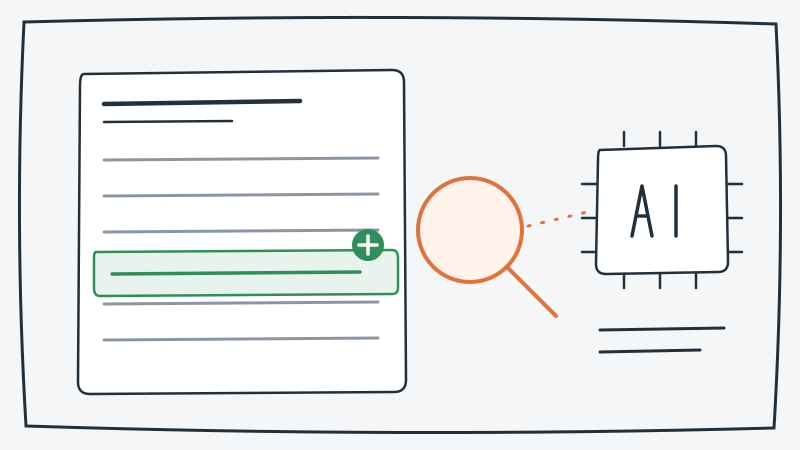
Most competitive intelligence teams watch pricing pages, changelogs, and job boards. Almost nobody watches a page that quietly discloses exactly which third-party technologies a competitor runs on: their subprocessor list.
A subprocessor list is the page (usually at a URL like /subprocessors, /legal/subprocessors, or linked from a Data Processing Agreement) where a company lists every external vendor it shares customer data with. GDPR, enterprise procurement, and SOC 2 all push companies to publish and maintain this page. Most keep it current because a stale list creates legal and contractual risk. That obligation is exactly what makes it valuable to you: it is a maintained, public, timestamped inventory of your competitor’s tech stack and vendor relationships.
This guide walks through what a subprocessor list reveals, how to read a new entry, and how to monitor the page so an added vendor lands on your desk within minutes instead of being discovered by accident.
Why a subprocessor list is a signal, not just a compliance page
The value is not in the list as it reads today. The value is in the change. When a competitor adds, removes, or swaps a vendor, they are telling you something about where the product is going before any of it shows up in a launch post.
Consider what a new subprocessor entry can mean:
- A new AI or LLM provider (OpenAI, Anthropic, a hosting layer for open models) appears months before the “AI features” announcement. Companies must disclose the subprocessor before customer data flows to it, so the legal page moves first.
- A new data warehouse or analytics vendor signals a data platform, reporting product, or a maturing analytics story.
- A payments or billing processor hints at a pricing model change, a self-serve motion, or international expansion.
- A new cloud region or hosting provider points at data-residency work, which usually means the competitor is chasing regulated or European enterprise buyers.
- A support, messaging, or CRM tool reveals how they run their go-to-market and support operation.
- A removed vendor is just as loud: a churned tool, a cost-cutting move, or a capability brought in-house.
Each of these is a roadmap signal, a talking point, or a buying-window indicator you can act on. The subprocessor page turns compliance boilerplate into a timeline of the competitor’s technical direction.
What a new entry actually tells you
Open any competitor’s subprocessor list and you typically get a table with a few columns that matter more than the rest.
1. The vendor name and purpose
Most lists include a short description of what each subprocessor does (“cloud infrastructure,” “email delivery,” “AI model inference”). A new row with a purpose like “large language model processing” is an unambiguous statement that the competitor is building AI features and routing customer data through a model provider. You do not need to guess from marketing copy. It is written on the legal page.
2. The date the entry changed
Well-maintained lists include a “last updated” date, and many publish a changelog or archive of past versions. That date is your timestamp. It tells you when the vendor relationship became real, which is almost always earlier than the public announcement. If you catch the entry the week it appears, you get a head start measured in months.
3. The data category and location
Some lists specify what data each vendor touches and where it is hosted. A subprocessor handling “customer content” in a new region tells you the competitor is preparing for a market with data-residency requirements. That is an enterprise-motion signal you can use to prioritize your own compliance messaging.
How to read a swap versus an addition
Not every change carries the same weight. Learn to tell them apart.
An addition is the strongest forward-looking signal. A brand-new category of vendor (the competitor’s first AI provider, first payments processor, first data warehouse) marks the start of a new capability.
A swap (replacing one vendor with a competing one in the same category) usually signals a cost, reliability, or performance decision rather than a new product. It is still useful for your own vendor evaluations and for battlecards, but weigh it differently.
A removal with no replacement is a retreat: a sunset feature, a cost cut, or a capability the competitor decided to build internally. Cross-reference it with their changelog and careers page to confirm which.
The pattern matters more than any single row. A competitor adding an LLM provider, then a vector database, then a new GPU hosting layer over three months is telling you an AI product is imminent, and roughly how serious the investment is.
Turning subprocessor changes into sales and product plays
A logged change is only useful if it drives an action. Here is how to operationalize the signal.
Feed your product roadmap. If a rival adds an AI inference vendor, your product team now knows the category is heating up and can decide whether to accelerate, differentiate, or hold. You are reacting to a real commitment, not a rumor.
Arm your sales team. When a competitor swaps to a cheaper infrastructure vendor right before a reliability-sensitive quarter, your reps have a concrete talking point. When a competitor removes a well-known security vendor, that becomes an objection-handling angle in enterprise deals.
Time your positioning. The gap between “vendor appears on the subprocessor page” and “feature is announced” is your window. Publish the comparison content, update the battlecard, and brief the field before the competitor’s launch, not after.
Confirm signals from other pages. A subprocessor change rarely travels alone. Pair it with hiring signals, changelog entries, and pricing-page edits to build a complete picture. The subprocessor list often moves first, so it becomes the early tripwire that tells you which of the other pages to watch closely.
How to monitor the page without checking it by hand
Reading a subprocessor list once is easy. Catching the one week it changes, across every competitor, is not. Nobody is going to load a dozen legal pages every morning looking for a new table row, and manual checks are exactly how a five-month head start turns into finding out at the same time as everyone else.
This is where automated website monitoring does the work. A tool like CAM watches the exact subprocessor URL for each competitor and alerts you the moment the page content changes, so a new vendor row reaches you within minutes of publication instead of on your next manual sweep. Because these pages are legally sensitive, competitors keep them accurate, which makes them one of the most reliable pages to monitor for change.
The practical setup looks like this:
- Find each competitor’s subprocessor URL. Check the footer, the privacy policy, the DPA, and the trust or security page. Search the site for “subprocessor” or “sub-processor.” Most B2B companies have one; if they serve enterprise or European customers, they almost certainly do.
- Add each URL to a change monitor. Point CAM at the page and set it to alert on content changes. A good monitor filters out formatting and timestamp noise so you are only pinged on a real change like an added or removed row.
- Route the alert to where you will see it. Send it to a Slack channel or email that your competitive intelligence, product, and sales teams actually watch.
- Log the diff. When an alert fires, capture what changed, the date, and the vendor’s purpose. Over a few months you build a timeline of each competitor’s technical direction that no single snapshot could give you.
The same monitoring discipline that catches subprocessor changes applies to the rest of a competitor’s surface area. Once the subprocessor page is wired up, extend it to their pricing and website changes so you catch the announcement that follows the vendor addition. If your competitive intelligence also feeds outbound, keeping the contact data clean with a validation layer like Scrubby makes sure the timely outreach you send off these signals actually lands.
The bottom line
A subprocessor list is one of the few pages a competitor is legally motivated to keep honest and current. That makes it a rare thing in competitive intelligence: a public, maintained, timestamped record of the vendors behind the product. Every new row is a decision the competitor has already committed to, disclosed before the marketing catches up.
Watch the page, read each change as a signal, and you convert a piece of compliance boilerplate into one of the earliest roadmap tripwires you have. Set up the monitor once with CAM, and the next time a rival quietly adds an AI vendor to their legal page, you will know before their customers do.