Most competitive intelligence stops at features and pricing. But when you sell into the enterprise, the decision often turns on something less glamorous: the service level agreement. Procurement and IT teams read the SLA line by line. They care about the guaranteed uptime percentage, the credit you owe when you miss it, and the exclusions that let a vendor wriggle out of paying. A competitor’s SLA page is one of the few places where a company puts a number on how reliable it is willing to promise to be, in writing.
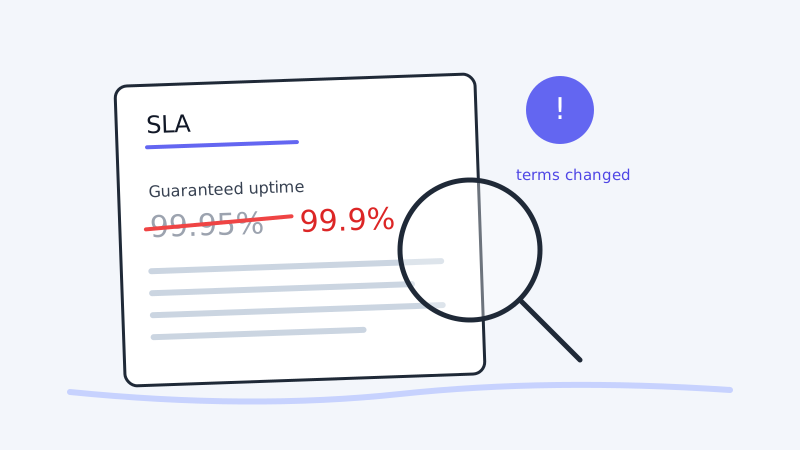
That number changes. When a competitor quietly drops a guarantee from 99.95 percent to 99.9 percent, or narrows what counts as “downtime,” or adds a carve-out for maintenance windows, they are revealing something. Almost nobody on the sales side is watching for it. This post is about how to track a competitor’s SLA and uptime commitments over time, and how to turn each change into a sales signal your enterprise reps can actually use.
Why the SLA page is an underrated signal
A status page shows you what already broke. An SLA page shows you what a company is willing to be held accountable for going forward. The two are related, but the SLA is the promise, and promises get renegotiated when reality does not cooperate.
Read carefully, an SLA tells you several things at once.
The headline uptime number is the commitment. Ninety-nine point nine percent allows almost nine hours of downtime a year. Ninety-nine point ninety-nine percent allows under an hour. The gap between those two tiers is the difference between a vendor that is confident in its infrastructure and one that is hedging.
The service credit schedule tells you how much that promise is actually worth. A vendor that offers a ten percent credit for missing its target is signaling far less confidence than one that offers a full month refunded. Some SLAs cap credits so low that the guarantee is theater.
The exclusions are where the real story lives. Broad carve-outs for “scheduled maintenance,” “force majeure,” “third-party providers,” or “beta features” quietly shrink the promise. When a competitor expands its exclusions, it is bracing for problems.
The tier gating tells you who actually gets a guarantee. Many vendors reserve their strongest SLA for the top-priced plan. If a competitor moves the 99.99 percent guarantee behind an enterprise-only tier, you have learned exactly what a mid-market prospect will not get from them.
None of this shows up if you read the page once. It only becomes intelligence when you capture the page repeatedly and compare versions.
What SLA changes actually tell you
Changes to an SLA rarely happen by accident. Legal and product leadership sign off on every word. So each edit is a deliberate signal.
When a competitor lowers its uptime guarantee, it is almost always because it could not consistently hit the old one. That is the single most actionable reliability signal you can find, and it is one a prospect will take seriously because it comes from the competitor’s own contract.
When a competitor weakens its credit terms, it is trying to reduce the financial cost of missing targets. Read together with a lowered guarantee, that is a company managing expectations downward.
When a competitor adds exclusions, it is carving out the exact scenarios that have been hurting it. New language about “regional degradation” or “dependency outages” tells you where the fragility lives.
When a competitor strengthens its SLA, that matters too. It may be moving upmarket, chasing regulated buyers, or responding to a deal it lost to you on reliability. Knowing that shapes how you defend your own accounts.
The point is that every direction of change is information. You just have to be watching when it happens.
Why manual checking does not work
The natural instinct is to bookmark the competitor’s SLA page and glance at it now and then. It fails for the same reasons manual competitive intelligence always fails.
SLA pages are legal documents, so the changes are small and easy to miss. A single phrase added to an exclusions list can gut a guarantee, and no human skimming the page will notice a new subclause. Worse, the old version disappears the moment they publish the new one. Unless you captured the previous text, you cannot prove the guarantee used to be higher, which is the exact evidence that makes the signal persuasive in a deal.
Reliability commitments have to be captured continuously and stored, or the change is invisible by the time it matters. This is precisely the recurring, difference-based monitoring that CAM is built for: it watches a specific page for meaningful changes, ignores cosmetic noise, and keeps a durable record of what the text said before and after. Instead of hoping you happened to reload the SLA on the right day, you get an alert the moment the terms change and a side-by-side history you can cite.
How to set up SLA monitoring
Treat it as a monitoring task, not a habit you have to remember.
Find the canonical SLA document. It is usually at competitor.com/sla, competitor.com/legal/sla, or linked from the terms of service and enterprise pricing pages. Capture the exact URL where the guaranteed numbers live.
Watch the fine print, not just the headline. The uptime percentage is the obvious target, but the credit schedule and the exclusions are where the meaningful edits happen. Monitor the full document so a new subclause does not slip past.
Filter out cosmetic noise. Legal pages get reformatted, dates change, and boilerplate gets reworded without changing meaning. You want alerts on substantive changes to the commitment, not every whitespace edit, so a monitor with a change-quality filter saves you from alert fatigue. With CAM you can point this at several competitors at once and let it surface only the real changes.
Keep a versioned timeline. The value compounds. A single SLA is a snapshot. A record showing a competitor walked its guarantee down over eighteen months is a narrative no rebuttal can erase.
Cover the whole reliability picture. Pair SLA monitoring with the competitor’s status page and their trust or security pages, so you see both the promise and the performance against it.
Turning SLA intelligence into sales angles
The intelligence is only useful if your reps can deploy it without sounding like they are attacking. The trick is to make the buyer curious rather than defensive.
Instead of saying “our competitor is unreliable,” give the prospect a question to ask in their own evaluation: “It is worth checking what uptime each vendor actually guarantees in the contract, and what credit you get if they miss it. Some guarantees have more exclusions than you would expect.” That reframes your advantage as due diligence, and it sends the buyer to read the competitor’s own document.
For technical and procurement stakeholders, the SLA is a natural talking point because it is contractual, not marketing. If you can show that a competitor recently lowered its guarantee or narrowed its definition of downtime, you are handing the buyer a concrete question to raise in their next call with that vendor. You do not have to characterize it. The change speaks for itself.
For your own outbound, a competitor’s SLA downgrade is a timing signal. Accounts that chose that vendor partly on a reliability promise are exactly the ones worth re-approaching when the promise shrinks. Reliability-driven outreach lands best when it is specific and well timed, and pairing that timing with a clean, calendar-first sequence through a tool like Kali turns the signal into booked conversations rather than ignored emails.
The compounding advantage
Any single SLA change is a small thing. A competitor moving from 99.95 to 99.9 percent is easy to shrug off in isolation. But an SLA history captured over quarters, showing the direction a competitor’s confidence is moving, is a durable asset your whole revenue team can draw on.
That is the real reason to monitor SLAs continuously rather than checking them occasionally. The individual data points are minor. The timeline is decisive. Competitors publish these commitments in the open and revise them in the open, and the teams that watch the changes turn a legal footnote into a reliable, verifiable edge in every enterprise deal.
Set up continuous SLA and uptime monitoring for your top competitors with CAM, and let the changes come to you.