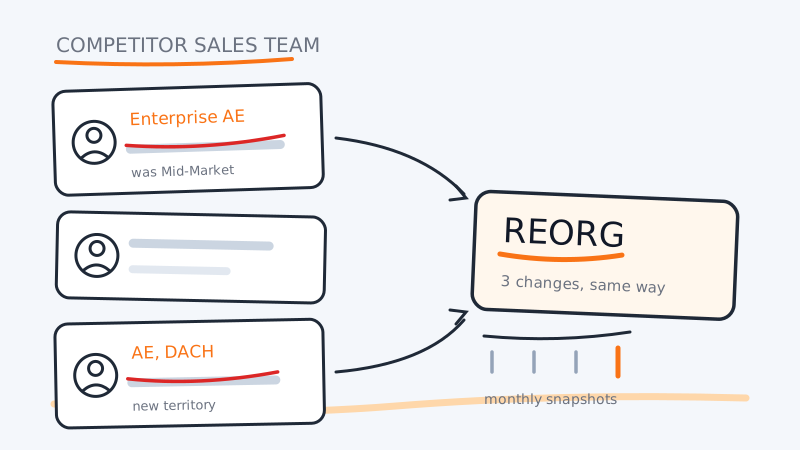
A competitor’s go-to-market strategy gets announced to the market about two quarters after it gets announced to their sales team. By the time the new segment language shows up on their homepage and the new vertical shows up in their case studies, the territory carve-up happened, the quotas were reset, and the reps have been selling the new motion for months.
There is a public, dated, surprisingly precise record of that internal change, and it is maintained voluntarily by the people closest to it. It is the job title line on each rep’s LinkedIn profile.
Reps update their titles fast, because a title is compensation-adjacent and career-adjacent. A new segment, a new region, or a promotion goes on the profile within days, long before anyone in marketing writes about it. And because titles at sales organizations are not decorative (they encode segment, territory, and account tier) the aggregate of a sales team’s titles is close to a readable map of how the company has decided to attack the market.
This guide covers what each kind of title change means, how to tell a policy change from one person’s promotion, and how to run the whole thing as a 20-minute monthly habit instead of an open browser tab you never get back to.
Why a title is better evidence than a job posting
Job-posting monitoring is the better-known version of this technique, and it works. But postings and titles answer different questions, and titles answer the harder one.
A posting is an intention. A title is a fact. A competitor can post ten enterprise account executive roles and fill two. Open headcount is a budget decision that may be reversed in the next board meeting. A title change means a human being is already sitting in that seat, with a quota attached to it.
Postings describe the future, titles describe the present allocation. If you want to know what a competitor plans to build, read their engineering postings. If you want to know which accounts their reps are being paid to win this quarter, read the sales team’s titles.
Titles survive the hiring freeze. When a competitor stops posting roles, posting monitoring goes dark. Internal reorganizations keep happening, and in a freeze they happen more, because the only way to cover a new segment is to move someone onto it. That is exactly the period where title monitoring is the only signal still producing data.
Titles are self-reported by the person with the most accurate information. Nobody knows the real shape of the sales org better than the people in it, and nobody has more incentive to describe their own role accurately and promptly.
The two sources are complementary, and the strongest read comes from holding them side by side. Our guide on how to monitor competitor hiring patterns to predict product moves covers the posting half of the picture.
The seven title changes that actually mean something
Most title edits are noise: a rep adds a certification, swaps “Account Executive” for “Account Exec,” or appends an emoji. Here are the seven patterns that carry real information.
1. Segment markers appearing or shifting
Watch for the words that bracket deal size: SMB, Commercial, Mid-Market, Enterprise, Strategic, Major Accounts, Global Accounts.
An “Account Executive” who becomes “Mid-Market Account Executive” tells you the org has grown enough to segment, which is itself a maturity signal. A “Mid-Market AE” who becomes an “Enterprise AE” tells you the company is pushing upmarket, and that the upmarket motion is being staffed from inside rather than hired from outside (which usually means the move is being tested, not committed to).
The reverse is louder and gets noticed less. When enterprise reps start reappearing as Commercial or Mid-Market reps, the upmarket experiment did not work. Enterprise cycles starved the pipeline, and the company is retreating to deals it can actually close. That is a six-month window where your enterprise deals get easier and their mid-market deals get harder.
2. Vertical markers appearing
“Account Executive, Financial Services.” “AE, Healthcare.” “Public Sector Account Executive.”
A vertical in a title is the single highest-confidence signal in this entire list, because vertical specialization is expensive. It means dedicated collateral, compliance work, often a dedicated SE, and a quota that cannot be covered by generalists. Nobody puts a vertical in a title speculatively.
When the first one appears, the competitor has committed to a beachhead. When the second and third appear in the same vertical within two quarters, that vertical is working and they are scaling it. Both are strategic facts worth a planning conversation, and both will show up in their marketing six to nine months later.
3. Geographic and territory markers
“AE, DACH.” “Enterprise AE, ANZ.” “Account Executive, Northeast.”
Region in a title means a territory now exists, which means someone decided the pipeline in that region justifies dedicated coverage. If a competitor’s first EMEA-titled rep appears, they are entering, not testing. Watch for the local-language profiles too: a rep whose profile headline switches to German or Japanese is a stronger expansion signal than any localized webpage, because hiring a native speaker is harder to reverse than translating a landing page.
Territory splits are also informative. When one “AE, EMEA” becomes three reps titled by subregion, that region hit the revenue threshold where carving it up pays for itself.
4. New-logo versus expansion splits
A single “Account Executive” population splitting into “New Logo AE” and “Account Manager” or “Expansion AE” is one of the most consequential changes you can observe, and almost nobody watches for it.
It means the company has separated hunting from farming. Two readings, and you can usually distinguish them from headcount: if the new-logo side is larger, growth is the priority and they are about to get more aggressive in your pipeline. If the expansion and retention side is larger, net new has slowed and they are defending the base. The second case is your opening, because defended bases are bases with unhappy customers in them. Pair the signal with what their reviews say and you have a target list, which is the approach in our guide on tracking competitor reviews to find churn risk and sales opportunities.
5. First appearances of a new sales function
The first instance of a role type is worth more attention than the tenth. Specifically:
- First Solutions Engineer or Sales Engineer. Their deals have gotten technical enough to need a pre-sales function. Expect deeper security and integration questions in your competitive deals, and make sure your own technical answers are current.
- First Partner or Channel Manager. They are building an indirect motion. Within a year their logo will start appearing in marketplaces and partner directories.
- First Sales Development Manager. Outbound is being industrialized rather than improvised. Your prospects are about to hear from them more often.
- First Revenue Operations or Enablement hire. The org crossed the size where process beats heroics. Their execution is about to get more consistent, which is less dramatic and more dangerous than any single hire.
- First Customer Success Manager with a renewals title. Renewals became a real risk they are now staffing against.
6. Account-tier and prestige language
“Named Accounts.” “Strategic Accounts.” “Key Accounts.” “Global Account Director.”
This vocabulary means account tiering exists: a specific list of logos has been assigned to a specific person. If you compete for large accounts, the appearance of named-account titles tells you your biggest targets now have a dedicated human assigned to them, and you should assume a persistent, multi-quarter campaign rather than opportunistic outreach.
7. Exits, and how they show up
Titles change to “ex-” prefixes, roles end with no new role appended, and headlines pick up open-to-work language. A single departure is a person. Several departures from the same segment or region inside a quarter is either a comp-plan change that went badly or a territory that stopped producing. Either way it is the best time to call into that territory that you will get all year.
How to tell a reorg from a promotion
This is the part that separates a useful habit from a stream of noise. Four rules.
One change is a person, three in the same direction is a policy. A single rep moving to enterprise got promoted. Three reps acquiring enterprise titles within a quarter is a strategy. Never escalate on a single profile.
Weight the manager layer heavier than the rep layer. Reps change titles for career reasons. Manager and director titles change because the org chart changed. A new “Director, Enterprise Sales” is worth more than four AE title edits, because the role had to be created, approved, and budgeted.
Require a second, independent source before you act. A segment shift in titles should be visible somewhere else: in open postings, in which case studies get published, in pricing page tiers, or in the language on the homepage. One signal is a hypothesis. Two independent signals is a finding you can take to a pipeline review. Website-side confirmation is covered in our guide to competitor website change tracking for repositioning signals.
Date everything, including the observation. Record the date you saw the title, not just the date the profile claims the role started. Start dates get backfilled and rounded to the month. Your observation date is the only timestamp you control, and the sequence of changes matters more than any single one.
Building the watchlist, concretely
You do not need the whole company. You need a stable sample you will actually re-check.
Pick 10 to 15 profiles per competitor. Include every sales manager and director you can find, the VP or CRO, and a spread of individual reps across whatever segments and regions you can already identify. Managers are the signal layer. Reps are the confirmation layer.
Take a baseline snapshot. For each person, record: name, profile URL, the exact title string verbatim, any segment, vertical, or region tokens in it, the stated role start date, their location, and today’s date. Verbatim matters, because the diff is the product. “Enterprise Account Executive” and “Account Executive, Enterprise” are the same role, but “Senior Enterprise Account Executive, Named Accounts” is three new facts.
Re-snapshot monthly. Quarterly is too slow to catch a sequence, weekly produces noise and churn. Monthly matches the cadence at which sales orgs actually change.
Diff the token sets, not the strings. Instead of eyeballing two title strings, compare the set of meaningful tokens (segment, vertical, region, function, seniority). This turns a subjective “did this change?” into a list of added and removed tokens, which is what you want in your notes anyway.
Keep a one-line log per change. Date observed, person, token added, token removed, your one-sentence read. Twelve months of that log is an org-chart history nobody else in your market has, and it makes the next reorg obvious within weeks instead of quarters.
Four plays to run off the signal
Upmarket push detected. Their enterprise motion is new and therefore immature: thin security documentation, no reference customers at size, SEs who just started. Refresh your enterprise battlecard around proof and references, and simultaneously raise activity in mid-market, which they are about to under-serve.
New vertical detected. You have roughly two quarters before their vertical content and case studies land. Use the window to publish first, get a reference customer in that vertical, and make sure your name is the one in the category when buyers there start comparing.
Expansion-heavy split detected. Net new has slowed and the base is being defended. Build a target list from their public customer logos and review complaints, and time the outreach to renewal cycles. Our guide to monitoring a competitor after losing a deal covers the sequencing.
Territory departures detected. A region that just lost reps has orphaned accounts and stalled deals in it. This is the highest-yield cold outreach moment in competitive selling and it lasts about one quarter.
Where automation fits
Title snapshots are genuinely manual work, and that is fine at 15 profiles a month. What does not scale manually is the layer underneath: knowing which accounts those reps are actually working right now. A title tells you which segment a rep was assigned to. It does not tell you which of your prospects they called last week.
That is the gap CAM is built for. You tell it which competitors to track, and it monitors their sales reps’ public LinkedIn activity, enriches what it finds with job title, company, industry, size, and location data, and scores each lead against your ICP so your team works the hottest ones first. It integrates with HubSpot, Salesforce, and Clay, so the signal lands where your reps already work rather than in a spreadsheet someone has to remember to open. The overview for sales teams walks through how teams put it to use.
If you would rather wire the data into your own model instead of reading it in a dashboard, CAM exposes a public REST API and a remote MCP server with tools for dashboard stats, account intelligence, priority-scored activity, and lead list management, so an agent can pull competitor activity on its own schedule. The API and MCP documentation has the full surface.
The practical division of labor: run the title watchlist monthly for the strategic read (where are they aiming), and let continuous monitoring handle the tactical read (who are they aiming at). The first tells you how to position next quarter. The second tells you which deal to call into today.
The monthly 20-minute routine
- Open your baseline sheet and pull up each of the 10 to 15 profiles.
- Copy the current title string verbatim into a new dated column.
- Diff the tokens and log only the changes: date, person, added, removed.
- Look for direction. Did two or more changes point the same way (same segment, same vertical, same region)?
- For any direction you found, look for a second source: postings, case studies, pricing tiers, homepage language.
- If two sources agree, write three sentences and send them to sales leadership: what changed, what it means, what to do differently.
- If only one source shows it, write it down as a hypothesis and check again next month.
Six steps of mechanical work and one step of judgment. The judgment step is the only part that cannot be delegated, and the twelve-month log is what makes it good.
What this will not tell you
Be honest about the limits when you brief leadership.
Titles lag the decision by weeks, so this is early warning, not advance notice. Titles are self-reported, so they are occasionally aspirational, especially at the manager layer. Some companies deliberately use flat or vague titles (“Account Executive” for everyone), and for those competitors this technique produces almost nothing and you should not force it. And a sample of 15 profiles is a sample: it tells you direction reliably and magnitude poorly.
None of that undermines the method. It means you treat titles as one dated input in a competitive picture rather than as the picture. The teams that get real value from this are not the ones who read profiles the most closely. They are the ones who wrote down what they saw, every month, for a year, and so recognized the pattern the third time it happened.
Start this month. Fifteen profiles, one column, one date. The log is the asset, and it only exists if you start it.