Most competitive intelligence programs obsess over pricing pages and product changelogs. They ignore one of the richest public sources a competitor produces: their investor relations page. If a competitor is publicly traded, or is a late-stage private company that publishes investor updates, they are legally and reputationally obligated to tell the market where the business is heading. That information is sitting on a page most sales teams never look at.
The problem is not access. The problem is timing. An earnings deck posted on a Tuesday afternoon contains sales-relevant intelligence that is most valuable in the following 72 hours, and almost nobody on a revenue team is watching for it.
Why Investor Relations Pages Are a Sales Goldmine
An investor relations page is where a company says what it actually believes about its own trajectory, filtered through the discipline of financial disclosure. Unlike marketing pages, IR content cannot exaggerate without legal consequences. That makes it unusually honest.
Here is what shows up on these pages that directly affects your deals:
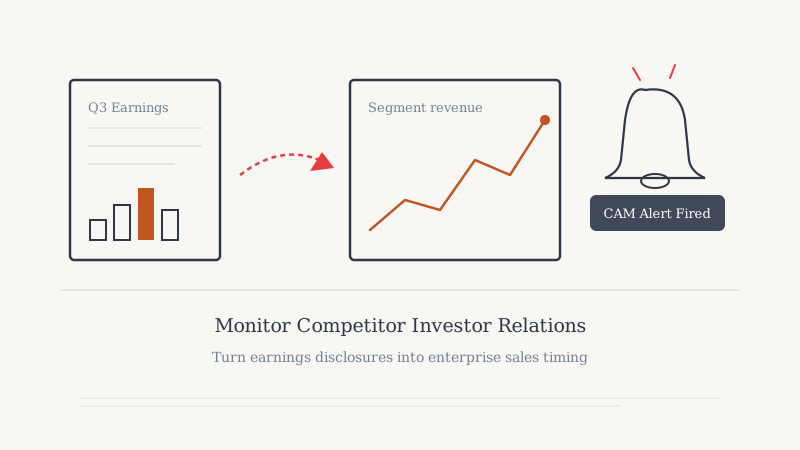
Segment performance. Earnings decks break revenue down by product line, geography, and customer segment. When a competitor reports that their enterprise segment grew 40 percent while SMB stalled, you now know exactly where they are pouring sales resources, and where they are vulnerable.
Guidance changes. When a company lowers forward guidance, it signals internal pressure. Sales teams under pressure discount harder, churn more, and stretch to close deals they should not. That context changes how you position against them.
Strategic priorities. Shareholder letters and earnings call scripts spell out the initiatives leadership is betting on. If a competitor tells investors they are “investing heavily in AI-driven onboarding,” you know what their next twelve months of product marketing will emphasize.
Customer and churn metrics. Net revenue retention, logo churn, and customer count are often disclosed. A declining retention number is a displacement opportunity you can act on before the market prices it in.
Restructuring and layoffs. Reductions in force, office closures, and reorganizations frequently surface first in an 8-K filing or an investor update, days before they hit the press. A competitor cutting their customer success team is a churn signal you can convert into pipeline.
What to Monitor on a Competitor IR Page
Investor relations content is spread across several page types, and each changes on a different rhythm. A complete monitoring setup watches all of them:
The main IR landing page. New links to earnings releases, updated event calendars, and added press releases usually appear here first. This is your highest-value single page to watch.
Quarterly earnings releases and decks. These drop on a scheduled cadence, but the exact posting time varies. Monitoring beats waiting for a press pickup by hours.
SEC filings pages. For public companies, 8-K, 10-Q, and 10-K links appear on the IR site. An 8-K filed outside the normal earnings cycle almost always means something material just happened.
Event and webcast calendars. When a competitor schedules an investor day or a conference appearance, they are about to make a strategic announcement. That is your window to prepare a counter-narrative.
Governance and leadership pages. Board changes and executive appointments often appear on IR governance pages before they are announced elsewhere.
The Manual Tracking Problem
The reason revenue teams do not use this intelligence is not that it is secret. It is that monitoring it manually is unrealistic. An analyst would have to visit six or more pages across every competitor, remember what each looked like last week, and spot the diff by eye. Nobody does this consistently, and the one week they skip is the week the competitor posts a guidance cut.
Earnings content also posts on no reliable clock. A company might say they report “after market close” and actually publish anywhere in a three-hour window. By the time a sales team hears about it secondhand, the prospect has already read it.
Automated monitoring removes the human bottleneck entirely. Tools like CAM watch each IR page continuously and fire an alert the moment the content changes, so the signal reaches your team the instant a new filing or deck goes live rather than days later in a market recap.
Setting Up Automated IR Monitoring
A practical setup for competitor investor relations monitoring works in two layers.
Layer 1: Landing page and filings index. Point monitoring at the main IR page and the SEC filings index. Any new link or content change triggers an alert. This catches new earnings releases, 8-K filings, and press releases as they appear.
Layer 2: Targeted document watches. Once an earnings page is live, monitor it for revisions. Companies sometimes correct or update decks and transcripts after posting, and those quiet edits can be revealing.
With CAM, you configure monitoring at either level, set the check frequency to match how time-sensitive each competitor is, and route alerts straight to Slack or email so the right people see them without logging into a dashboard.
A realistic setup for a team tracking three public competitors might look like:
- Primary competitor IR landing and filings pages: checks every few hours, Slack alert to the competitive intelligence channel
- Secondary competitors: daily checks, email digest to the sales leadership team
- Event calendars: daily checks, compiled into a weekly planning note
Turning an IR Alert Into an Enterprise Sales Play
An alert only matters if it produces action. When an investor relations change comes in, run it through a fast triage: does this create leverage in an active deal, and does it open an outbound window?
Deals in flight. Pull any enterprise opportunity where this competitor is the incumbent or the alternative. If their earnings showed weakening retention or a guidance cut, brief the rep with a value-stability angle: buyers signing multi-year enterprise contracts care deeply about vendor durability.
Displacement outbound. A competitor reporting layoffs in customer success or support is a churn-risk signal. Build a target list of their customers and reach out with a migration-readiness angle before renewals come up.
Positioning updates. If a competitor tells investors they are pivoting toward a new segment or product bet, update your battlecards within 24 hours. Reps who can speak credibly to a competitor’s stated strategy win trust in enterprise rooms.
Timing large plays. An investor day or major earnings announcement is a moment of market attention. Timing your own campaign, launch, or outreach around it, or deliberately away from it, is a strategic decision you can only make if you know it is coming.
The Intelligence You Build Over Time
A single earnings update is a data point. A multi-quarter history of a competitor’s IR disclosures is a strategic asset.
Tracking these changes over time reveals patterns that no single filing shows: which segments a competitor consistently over-invests in, how their retention trends quarter over quarter, and how their stated priorities shift as the market changes. That longitudinal view feeds not just sales conversations but your own board reporting, product roadmap, and go-to-market planning.
Pairing IR monitoring with other competitor signals, like pricing page changes and hiring patterns, produces a fuller picture of where a competitor is actually heading versus where their marketing claims they are. That gap between stated strategy and financial reality is where the sharpest competitive positioning lives.
The tooling for this has to be reliable and quiet. Monitoring that generates false positives on every stock ticker refresh gets ignored, and monitoring that requires manual setup per filing gets abandoned. The setups that last are the ones that surface only material changes and route them to the people who can act, automatically.
That is the standard CAM is built around: continuous, automated monitoring that turns a competitor’s own public disclosures into enterprise sales intelligence, without adding a single recurring task to your team’s week.