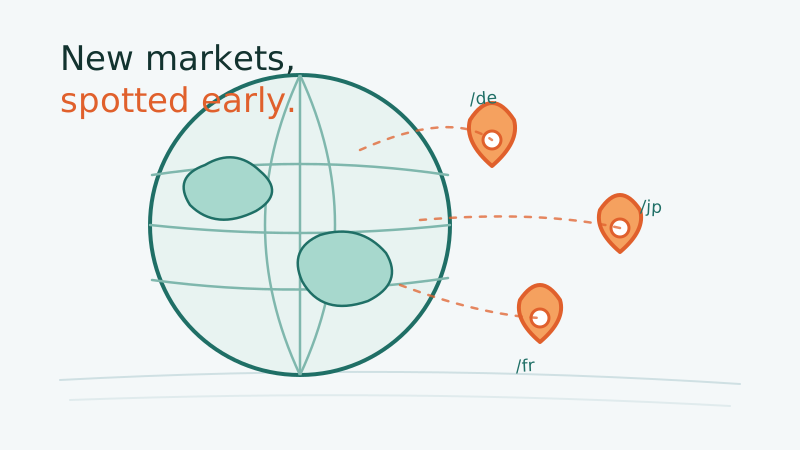
Most competitive intelligence programs are fluent in the signals that live on a competitor’s homepage: pricing changes, new features, fresh case studies. Far fewer teams watch the signal that tells you where a competitor is about to sell, not just what they are selling. When a company adds a localized version of its site, a new country subdirectory, a translated pricing page, or a second currency at checkout, it is announcing a geographic expansion. It usually does so quietly, in the site structure, weeks or months before a single press release goes out.
That gap is an opportunity. If you can see a competitor building the infrastructure to enter a new region, you can defend accounts, adjust positioning, and brief your reps in that market before their sales motion ever reaches a live deal. The problem is that these signals are scattered across subdomains, URL paths, and hreflang tags that no one on your team is checking by hand.
Why a Localized Page Is a Market Entry Signal
Standing up an international presence is not a cosmetic change. It is a deliberate, resourced decision that leaves fingerprints all over a website.
It signals committed investment in a region. Translating a marketing site, localizing a pricing page, and configuring region specific legal terms costs real money and real headcount. A competitor that publishes a German or Japanese version of its site has already decided that market is worth pursuing. They are not testing the water, they are wading in.
It exposes their sequencing. The order in which a competitor localizes tells you their priority list. A company that ships Spanish and Portuguese before anything else is chasing Latin America. One that leads with German, French, and Japanese is going straight for large enterprise economies. That sequence is a roadmap of where their revenue team will show up next.
It reveals pricing and packaging by geography. Localized pricing pages frequently expose region specific price points, currency conversions, and tier structures that differ from the flagship market. That is pricing intelligence you cannot get from the main site, and it tells you how aggressively they intend to compete on cost in each region.
It maps their compliance readiness. New localized legal pages, a fresh privacy notice referencing GDPR or a regional data residency claim, or a country specific terms of service page all indicate the competitor has done the compliance work required to sell there. That is a strong sign the expansion is real and imminent, not aspirational.
What to Watch For
Not every change to an international page matters. Focus monitoring on the handful of structural signals that reliably precede a market entry.
A brand new country subdirectory or subdomain. The first appearance of a path like /de, /fr-ca, or a jp. subdomain is the headline event. It is the clearest possible evidence that a new market is coming online. Pair this with monitoring the competitor’s subdomains and sitemap so a newly published section does not slip past you.
New hreflang tags in the page source. Search engines rely on hreflang annotations to serve the right regional page to the right visitor. When a competitor adds hreflang entries for languages or regions that were not there before, they are preparing to rank in those markets. This lives in the HTML head, invisible to a casual visitor but obvious to a monitor that reads the source.
A new currency or region on the pricing page. When checkout starts offering euros, yen, or a country specific plan, the competitor has wired up regional billing. That is one of the last steps before they can actually transact in a market, which makes it a high urgency signal.
Localized job postings and regional office mentions. A careers page that suddenly lists roles in Munich or Singapore, or an about page that names a new regional office, corroborates a site level expansion signal. When the website and the hiring board point at the same region, the move is confirmed.
Translated content and localized case studies. A competitor publishing case studies featuring customers in a new region, or translating its core content, signals that it has reference accounts and a go to market story ready for that market.
The Problem With Checking Manually
You could, in theory, bookmark a competitor’s site and periodically poke around for new language versions. In practice this fails for three reasons.
International signals hide in places a human eye skips: hreflang tags in the page head, a currency toggle buried in a checkout flow, a new path that only appears if you already know to look for it. A person browsing the homepage will never notice them. The pages also change constantly with cosmetic churn, rotating hero images, reordered logos, and timestamp updates, so a raw diff buries the one structural change that matters under a pile of noise. And the signal is time sensitive: the value of knowing a competitor is entering your region comes from the head start, and a quarterly manual sweep erases that head start every time.
This is exactly the kind of recurring, structural monitoring that should never be a human’s job. Instead of remembering to check, you set a watch once and get told only when something real changes.
How to Automate International Expansion Monitoring
The reliable approach is to point a monitoring tool at the surfaces where expansion shows up first and let a change judge decide what deserves an alert. CAM is built for precisely this pattern: you hand it the URLs and page sources you care about, and it watches them continuously so no one on your team has to.
Track the sitemap and homepage source. Monitoring the sitemap catches new localized paths the moment they are published, and watching the homepage HTML surfaces new hreflang tags and language switchers as soon as they appear. These are the earliest structural tells of an expansion.
Watch the pricing and checkout pages for new currencies. Point a monitor at the pricing page so a new currency, a region specific plan, or a localized price point triggers an alert instead of going unnoticed until a rep runs into it in a deal.
Filter out the cosmetic noise. The reason manual diffing fails is that marketing pages churn constantly. CAM runs every change through a judge that ignores formatting shifts, image swaps, and timestamp updates, so the alerts you get reflect an actual structural change like a new locale or currency. You can read more about how CAM filters noise and routes only meaningful changes on the product site. That difference is what separates a monitor your team trusts from one they mute after the third false alarm.
Route each signal to the right owner. A new currency on the pricing page is intelligence for your revenue team. A new localized subdirectory is positioning intelligence for product marketing and regional leadership. Send each signal to the people who can act on it.
Turning a Geographic Signal Into Action
An alert only matters if it changes what someone does. When a competitor’s international footprint moves, run it through a quick read.
A new locale means brief your reps in that region now. If a competitor just published a French site, your reps in France will start hearing about them in deals. Get ahead of it: arm the team with the differences in your commercial model, your local support, and your compliance posture before the competitor’s name comes up cold.
A new currency means they can transact there. Regional billing is one of the final steps before a market goes live. Update your battlecards to reflect that the competitor now sells locally, and coach reps on where your pricing and terms hold up better in that geography.
Sequenced localization means a funded, deliberate push. When a competitor localizes several markets in a short window, treat it as evidence of a well resourced international motion. Pair it with their funding news and hiring signals to size the threat accurately, and consider accelerating your own expansion into contested regions.
Feed regional pricing back to your strategy. Localized pricing pages often expose geography specific discounting the competitor hides in its flagship market. That is direct input for your own regional packaging and discount guardrails. If you are planning outbound into those same markets, clean, deliverable contact data matters just as much, and tools like Scrubby help keep a regional prospect list validated before you send.
The Compounding View
A single localized page is a data point. A tracked history of a competitor’s geographic expansion is a strategic asset. Over time you see which markets they entered, in what order, how their regional pricing evolved, and how quickly a new locale went from a translated page to a live billing currency. That timeline tells you not just where they are, but how fast they move when they commit to a market.
Pair that view with the signals your team already watches, like pricing changes, changelog updates, and hiring patterns, and scattered observations become a real intelligence program. Localized pages tell you where a competitor has decided to sell; the other signals tell you how fast they are getting there. Continuous, automated monitoring across those surfaces is the standard CAM is built for, surfacing only the meaningful changes to the people who can act on them.