If you have ever wanted an email the moment a competitor edits their pricing page, you have probably installed Distill.io. It is one of the most loved change detection tools on the market and for good reason: install the browser extension, select a chunk of a page, pick a check interval, and it watches that selection for you. For a few URLs it is close to perfect, and it is free to start.
The trouble arrives quietly, usually around month two. Your watchlist has grown from three URLs to thirty. Half of them fire alerts you no longer read. You cannot remember which watch is pointed at what, your teammate cannot see any of it because the watches live in your browser, and nobody on the sales team has ever once acted on one of the emails. You did not fail at using the tool. You outgrew the job it was built for.
This post covers what Distill.io genuinely does better than most alternatives, the four specific walls teams hit when they try to run competitive intelligence out of a change watcher, and how to decide whether you need a better watcher or a different category of tool entirely.
What Distill.io does well
Credit where it is due. Distill.io is a well-built product with real advantages over heavier monitoring platforms:
- Visual selector in the browser. Because it runs as an extension inside the page you are looking at, you can click the exact element you care about. That beats guessing at CSS selectors in a web dashboard.
- Local monitoring option. Distill can run checks on your own machine, which means it can watch pages behind a login that a cloud crawler would never reach. That is a legitimately useful capability most alternatives do not have.
- Tight check intervals. For a page you truly need to catch within minutes, such as a restock, a ticket drop, or a filing page, frequent local checks are hard to beat.
- Text, visual, and source modes. Being able to diff rendered text, the screenshot, or the raw HTML gives you a way to catch changes that never appear on screen, like a meta tag or a hidden script.
- Cheap to start. The free tier covers a handful of watches, so there is no procurement conversation standing between you and your first alert.
If your need is literally “tell me when this one page changes,” that is the job Distill was designed for, and you should not over engineer it. The problems below are not bugs. They are what happens when a single-URL tool gets handed a multi-competitor mandate.
Wall 1: a watchlist is not a monitoring strategy
A change watcher starts with a URL. Competitive intelligence starts with a question, usually something like “are our two main competitors moving upmarket?”
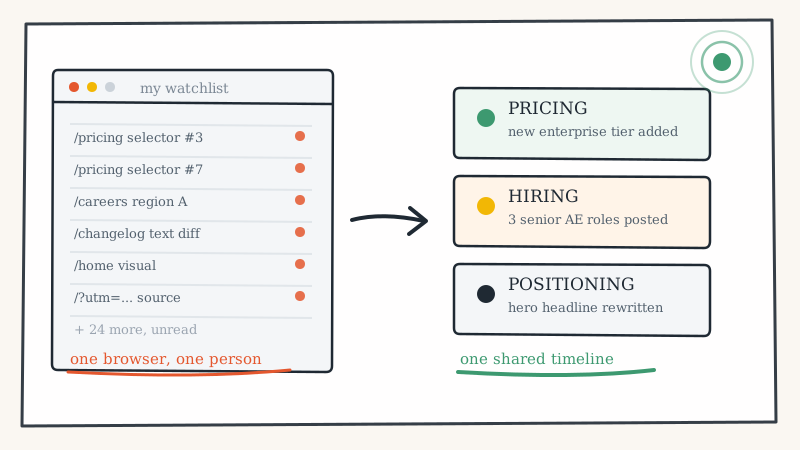
Those are not the same shape. To answer the upmarket question you need to see a competitor’s pricing page, their security and trust pages, their job postings, their customer logos, and their homepage headline, and then read all of it together. In a watchlist, each of those is a separate unrelated row that fires a separate unrelated email on a separate day. The pattern across them, which is the actual intelligence, never assembles anywhere. You are the assembly step, and you are doing it from memory.
This is why teams who track competitors seriously organize monitoring around the competitor and the signal type rather than around the URL. If you want a concrete picture of what that looks like in practice, the walkthrough on how to build a competitive intelligence dashboard in 30 minutes lays out the signal buckets worth keeping separate.
Wall 2: noise trains you to ignore the alerts
Every generic change detector has the same structural problem. It cannot tell the difference between a change that matters and a change that does not, because it has no idea what the page is for.
Here is what actually generates alerts on a modern marketing site:
- Rotating testimonial quotes and customer logo carousels
- A/B test variants serving different copy to different checks
- Cookie banners, chat widgets, and consent modals
- Build hashes and cache-busting parameters in the page source
- Dynamic “trusted by 4,312 teams” counters
- Dated blog modules in the footer that change every time anything is published
None of that is a competitor move. All of it fires. You can fight it with tighter selectors and ignore rules, and you will spend an afternoon a month doing exactly that. The end state for most people is an email filter that routes the alerts into a folder they never open, which is functionally the same as not monitoring at all.
The alternative is monitoring that classifies the change before it reaches you. CAM is built around that distinction: it watches a competitor’s footprint continuously and alerts on changes that look like strategy, with the cosmetic churn filtered out, so the alert still means something in week twelve.
Wall 3: the intelligence lives in your browser, not in your company
This is the wall that kills most Distill-based programs, and it has nothing to do with detection quality.
Extension-based watches are personal. They live in one person’s browser profile, on one person’s laptop, under one person’s account. That creates three problems at once:
- No shared visibility. The product marketer who owns battlecards cannot see what the founder is watching. Two people end up monitoring the same pricing page and nobody is watching the changelog.
- No history anyone can search. When a rep asks “didn’t they change their pricing around June?” there is no team-accessible record. The diffs are in someone’s inbox.
- Single point of failure. When the person who set up the watches changes laptops, leaves, or simply turns off their browser for a week, the competitive monitoring program silently stops. Nobody notices until a deal is lost to a competitor move from a month ago.
Local monitoring is a feature when you need to watch a page behind a login. It is a liability when it is the only place your competitive intelligence exists. If the record is not shared and searchable, you do not have a program, you have a habit.
Wall 4: you get a diff, not a decision
Say the detection works perfectly. A real change lands, correctly, in your inbox. You now have a before-and-after of some HTML.
What you needed was: what changed, why it matters, and what we do about it. Converting the first into the last three is manual analyst work every single time, and it is the part that does not scale. Ten competitors and twenty-five watched pages produce a part-time job that nobody’s quarterly goals include, so it gets skipped, and the alerts pile up unread.
The useful output of competitive monitoring is not a diff. It is a sentence a rep can say on a call. A monitoring workflow that ends at the diff hands the hardest step back to you, which is why most watchlists quietly die. If you want the bridge from raw change to usable asset, the process for turning signals into a competitor battlecard from monitoring data is the piece most teams are missing.
Distill.io versus a competitive intelligence tool
A clean way to see the split:
| What you need | Change watcher | Competitive intelligence tool |
|---|---|---|
| Watch one page you chose | Strong fit | Overkill |
| Watch a page behind a login | Strong fit with local checks | Often not possible |
| Catch a restock or a filing in minutes | Strong fit | Not the design goal |
| Track 10 competitors across many pages | Breaks down | Core use case |
| Separate strategy from cosmetic edits | Manual rules | Built in |
| Shared team history of competitor moves | Not available | Core use case |
| Output a sales team will act on | You write it | Part of the product |
Read the rows, not the totals. If your real answers cluster in the top three rows, keep Distill and stop reading. If they cluster in the bottom four, no amount of better selectors will fix it, because the gap is category, not configuration.
How CAM approaches the same problem
CAM starts from the competitor rather than the URL. You add the companies you compete with, and monitoring is organized around the signals that reveal strategy:
- Signals grouped by type. Pricing and packaging, hiring, product and changelog activity, positioning and messaging, customer and logo changes. You see what kind of move happened, not that some bytes shifted.
- Change filtering by default. Cosmetic churn, rotating content, and build noise are suppressed so the alerts stay credible.
- A shared, searchable record. The timeline belongs to the team, not to one browser profile, so “when did they change pricing?” has an answer six months later.
- Output shaped for go to market. Alerts read like a short brief, which is what a rep prepping a competitive call or a marketer updating positioning actually needs.
The one-line version: Distill.io tells you a page changed, and tells only you. CAM is built to tell your team what a competitor is doing.
If you are migrating off a watchlist
You do not need to rebuild from scratch. Do this in an hour:
- Export the watchlist and group it by competitor. You will usually find three or four companies account for most of the rows, and a long tail of one-off URLs you forgot about.
- Delete the dead weight. Any watch that has not produced an alert you acted on in 90 days is noise. Cut it.
- Name the question for each competitor. “Are they going upmarket?” or “Are they about to launch in our category?” The question determines which pages matter.
- Keep local monitoring only where it earns its keep. Pages behind a login are a real edge case where a local watcher still wins. Leave those in place and move everything public to shared monitoring.
- Decide where alerts land. A shared channel the whole go to market team reads, not a personal inbox. If sales never sees the signal, the signal never becomes revenue.
Step five is the one people skip, and it is the difference between a monitoring tool and a monitoring program.
From signal to action
None of this matters unless the alert changes what someone does. A competitor raising prices, sunsetting a product, or quietly dropping a marquee logo from their homepage is an opening with a short shelf life. The window where that intelligence is worth something is measured in days.
So wire the back half too. When a signal lands, update the battlecard, brief the reps on the new language, and reach out to the accounts most exposed to the change while it is still news. Outbound timing tools like Kali help you get those competitive displacement conversations booked while the signal is fresh, and keeping that outreach list verified with Scrubby means the brief actually reaches a human instead of bouncing. Monitoring finds the opening. Outreach is what converts it.
The bottom line
Distill.io is an excellent change watcher, and for a short list of pages, including ones behind a login, it is still one of the best options available. It is simply not a competitive intelligence system, and no configuration makes it one, because the gaps are classification, shared history, and interpretation rather than detection.
The honest test is one question: if the person who built your watchlist went on vacation for three weeks, would your team still know what your competitors did? If the answer is no, you have outgrown the extension, and it is time to put competitor monitoring somewhere the whole team can see it.