Most competitive intelligence work is inference. You watch a pricing page shift, a job posting appear, a headline change, and you reason backwards to a strategy. You are reading smoke and guessing at the fire.
Public procurement is the exception. When a competitor wins a government contract, a public record appears with the buying agency named, the dollar ceiling stated, the period of performance defined, and the competition type disclosed. You are not inferring that they closed an enterprise deal. You are reading the contract.
Almost nobody in B2B competitive intelligence uses this. Teams who sell exclusively to commercial accounts skip it on the assumption that it does not apply to them, which is backwards: a competitor’s public sector contracts tell you a great deal about their commercial motion too, because the same product, the same security posture, and the same implementation team serve both. And teams who do sell into government usually treat procurement portals as a bid-finding tool rather than a competitor-watching one.
This post covers which sources to monitor, how to read an award notice properly (most of the signal is in fields people skip), what each pattern tells you, and the plays that follow.
Why procurement records beat almost every other CI source
Three properties make this data unusually good.
It names the customer. Case studies name customers who agreed to be named, which skews heavily toward happy flagship accounts. Award notices name the customer whether or not anybody wanted it published. You get the unflattering wins and the small pilots alongside the trophies.
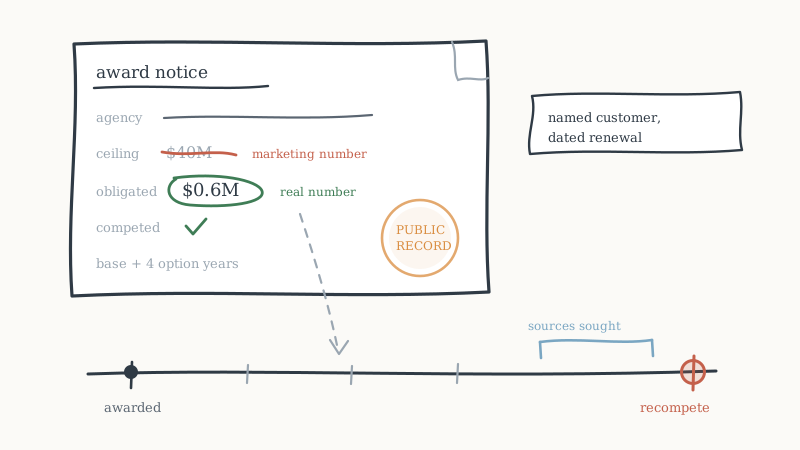
It carries a date you can act on. Nearly every other competitive signal tells you something happened. An award record tells you when the thing ends. A five-year contract awarded in March 2024 has a recompete window in late 2028, and the market research phase starts a year before that. No other public source hands you a dated sales opportunity that far out.
It includes the money. You see obligated value, ceiling value, and modifications. Over time that lets you measure whether a competitor’s public sector business is actually growing or whether they won one big vehicle in 2022 and have been coasting on it since.
The sources worth monitoring
Coverage varies by region, so build the list that matches where your competitors sell.
United States federal. SAM.gov carries active solicitations and contract award notices, and is the system of record for entity registration. USAspending.gov is the better analytics layer over the same underlying federal procurement data, with an API and bulk downloads. The Federal Procurement Data System feeds both and is where the detailed contract action fields live. GSA eLibrary and GSA Advantage tell you whether a competitor holds a Multiple Award Schedule contract and, critically, what prices they published on it.
US state and local. This is fragmented and therefore under-watched, which makes it valuable. Most states run their own procurement portal, and large cities and school districts publish board agendas with award items on them. Board meeting minutes are an unusually rich and unusually ignored source: they often contain the evaluation summary and the losing bidders.
United Kingdom. Contracts Finder covers central government and the wider public sector above threshold. Find a Tender replaced the EU notices for UK procurement after 2021.
European Union. TED (Tenders Electronic Daily) publishes contract award notices across member states, with the awarded supplier and value.
Canada and Australia. CanadaBuys publishes tender and award notices federally. AusTender publishes contract notices with supplier, value, and dates.
Education and research. If your category touches universities, grant databases matter. NIH RePORTER, NSF awards, and the equivalent national research councils show which institutions received funding for work that requires tooling in your category. That is a buying signal before any procurement notice exists.
How to actually read an award notice
This is where most people stop short. They read the headline number and move on. The fields underneath are where the intelligence is.
Obligated value versus ceiling value. A press release will say “awarded a contract worth up to $40 million.” The ceiling is a cap, not revenue. What matters is the obligated amount, which is the money actually committed. A $40 million ceiling with $600,000 obligated is a pilot with an option to grow, not a $40 million win. Competitors routinely market the ceiling. Correct for it.
Contract vehicle type. A single-award contract means the agency committed to one vendor. An IDIQ or BPA with multiple awardees means your competitor earned the right to compete for task orders, nothing more. These are frequently reported as equivalent and they are not remotely equivalent. Winning a slot on a multiple-award vehicle is a qualification event. Winning a task order under it is a sale.
Competition type and extent competed. “Full and open competition” tells you they beat a field. “Sole source” with a published justification tells you the agency argued no alternative existed, and that justification document often states the technical reason in detail. Read it. It is effectively a competitor-written explanation of why they are hard to displace, and it names the specific capability gaps the agency believed others had.
Set-aside designation. If the award was reserved for a small business or a specific socioeconomic category, your competitor’s win says less about product strength than about eligibility. It also has an expiry: companies grow out of small business size standards, and when they do, their entire set-aside pipeline becomes contestable.
Period of performance and option years. Base period plus options is the real structure. An agency exercising every option year signals satisfaction. An agency letting an option lapse and re-competing early signals the opposite, and that is one of the strongest displacement signals in the entire dataset.
Modifications. Scope-increase modifications mean the deployment is expanding. A de-scoping modification or a partial termination means something went wrong. Termination for convenience is a polite phrase with an impolite meaning.
NAICS and PSC codes. These classify what was actually bought. If a competitor’s awards start appearing under codes outside their historical range, they are either expanding the product or repositioning to chase budget lines. Code drift is an early and quantitative read on strategy change.
The patterns and what they mean
Individual awards are data. Patterns are intelligence.
Agency concentration. One agency at 70 percent of a competitor’s public sector obligations is a single point of failure. You know exactly which recompete to prepare for and roughly what it is worth to them.
Geographic or vertical drift. Awards moving from a handful of civilian agencies into defense, or from one state into five, means they built the compliance and past-performance footprint to operate in a new segment. That footprint cost them real money and usually shows up in hiring first.
Sudden silence. A competitor who won steadily for three years and nothing for the last six quarters has a problem: a lost vehicle, a failed audit, a compliance lapse, or a quiet strategic retreat. Public sector pipelines are slow, so silence is meaningful in a way it is not in commercial sales.
Teaming and subcontracting position. Check whether your competitor is the prime or a subcontractor. Moving from sub to prime is a genuine maturity step. Moving the other way is a retreat, often after a failed prime attempt.
Pricing exposure. A published GSA schedule price list is your competitor’s rate card. Not an estimate, not a leaked figure from a deal, the actual published number they are contractually bound to. If your category has schedule holders, this is the cleanest pricing intelligence available anywhere, and it is fully public.
Turning records into plays
The recompete calendar. For every competitor contract in your category, record the end date and work backwards. Market research and sources-sought notices usually land twelve to eighteen months before the award. Those notices are the real entry point, because that is when requirements are still being written and can still be influenced. Build a rolling calendar and treat each entry as a dated opportunity rather than a fact.
The expansion follow. When a competitor wins at an agency, peer agencies with similar mandates become likelier buyers in your category. The budget justification already exists, written by someone else. Your competitor will work that list, so you should be working it at the same time.
The sole-source counter. Read the justification document for every sole-source award your competitor received. It tells you precisely which capability the agency believed was unique. Either you have it and your positioning is failing to communicate it, or you do not and you now know what to build or partner for.
The size-standard window. Track when a competitor graduates out of a small business category. Their set-aside pipeline opens up to the field at that moment, and they will be structurally slower to adjust than you are.
The commercial read-across. This is the play commercial-only teams miss. A competitor achieving FedRAMP authorization, winning a defense contract, or passing a state security review built capabilities that show up in their commercial enterprise pitch within two quarters. The procurement record is an early warning that their commercial security story is about to get stronger. Prepare the counter before you meet it in a deal.
Where the paper trail ends
Procurement data has one structural limitation, and it is a big one. It is retrospective and slow. An award notice describes a decision made months earlier, after a procurement cycle that began a year or more before that. The entire sales motion that produced the win happened invisibly, and by the time you can read about it, it is finished.
Worse, the records only exist for the deals your competitor won. There is no public notice for the commercial enterprise account their account executive started working last Tuesday, which is where most of your losses actually come from.
That is the gap CAM was built to close. CAM continuously monitors the new LinkedIn connections your competitors’ sales reps make, enriches each one with job title, company, industry and location data, scores it against your ICP, and delivers a ranked lead list every week alongside real-time alerts. Where an award notice tells you a competitor closed a public sector deal nine months ago, connection monitoring tells you which accounts their reps are opening right now, with leads syncing into HubSpot, Salesforce, or Clay so the signal lands in the tool your team already uses. If you want to see the mechanics of what gets captured, the LinkedIn connection tracking breakdown walks through it.
Use both layers for what each is good at. Procurement records give you dated, dollar-denominated, customer-named history and a recompete calendar you can plan a year around. Connection monitoring gives you the live pipeline. One tells you where your competitor has been. The other tells you where they are going this week.
A one-week starting plan
Day one. Look up your three closest competitors by legal entity name in USAspending and SAM.gov. Use the registered entity name, not the brand name, and check for subsidiaries. Record total obligations by year.
Day two. Pull every active contract for those competitors into a sheet with agency, obligated value, ceiling, end date, and competition type. Sort by end date. That sorted column is your recompete calendar.
Day three. Check GSA eLibrary for schedule holdings in your category and download any published price lists. Compare against your own pricing honestly.
Day four. Read the justification documents for any sole-source awards. Write down each claimed unique capability and mark whether you have it.
Day five. Set up recurring monitoring. The USAspending API supports filtered queries, so a weekly automated pull keyed to your competitors’ entity identifiers plus your category codes will surface new actions without manual checking. Add a change-detection watch on the relevant international portals.
The takeaway
Public procurement is the only competitive data source that hands you the customer name, the contract value, and the renewal date in the same record. The signal is not in the headline dollar figure, which is usually a ceiling and usually overstated in marketing. It is in the obligated amount, the competition type, the set-aside status, the option-year behavior, and the modification history.
Read those fields and you get a recompete calendar, a published competitor rate card, a list of peer agencies with pre-written budget justifications, and an early warning on the enterprise security capabilities your competitors are about to start selling commercially.
Then accept what the data cannot do. It is a record of finished deals. Pair it with continuous monitoring of what competitor sales teams are doing right now, and you stop reading history and start seeing the pipeline while it is still contestable.