
Track Competitor Podcast Appearances to Extract Real Sales Talking Points
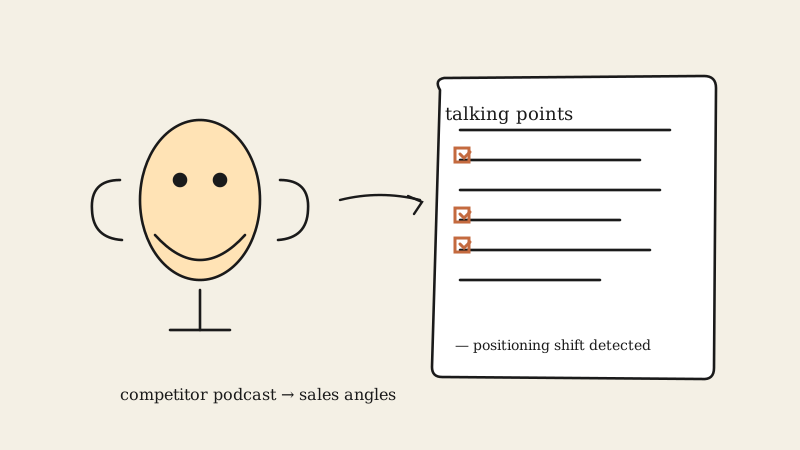
Track Competitor Podcast Appearances to Extract Real Sales Talking Points
A competitor’s website is a curated artifact. Marketing wrote it, legal reviewed it, and the messaging is exactly what the company wants the public to see. A competitor’s executive on a 60-minute podcast is something completely different. Off the prompt, in conversational mode, talking to a host who pushes for specifics, the same exec will say things they would never put in a press release: which deals they lost and why, where the product is weak, which segments they are pulling out of, which they are doubling down on.
Those off-the-cuff comments are some of the most actionable intelligence your sales team can get. They are also almost completely ignored, because nobody on the team has time to listen to two-hour podcast episodes hoping a competitor name comes up.
This is one of the highest-leverage monitoring loops a sales-driven company can build. Done right, it produces a steady stream of sales talking points and positioning ammunition that nothing on a website or LinkedIn page can match.
Why podcast appearances reveal what marketing pages hide
Three things change when an executive moves from written content to a podcast interview.
The format rewards specificity. Hosts ask follow-up questions. Vague answers sound evasive on audio in a way they do not in a blog post. So execs name customers, name competitors, and quote actual numbers far more often than they would in a written piece.
There is no legal review. The exec is talking, not signing off on a draft. They make claims and reveal preferences in real time. By the time the audio is published, anything legal would have softened is already out there.
The audience is industry insiders. Most B2B podcast audiences are operators, not customers. Execs unconsciously calibrate their answers for that audience: more candid about challenges, more revealing about strategy, more willing to take shots at the market. The result is a much more honest picture of how the company actually thinks.
A typical 45-minute episode with a competitor CEO contains, on average, three to seven extractable competitive intelligence points: a product roadmap hint, a segment focus shift, a pricing comment, a hiring direction, a candid weakness, a stated metric. Multiplied across the 5 to 15 podcasts a competitor exec might do in a year, this is one of the richest unstructured data sources available about any rival.
What to extract, and how to use it
The mistake is treating a podcast episode as a passive update. The right frame is to treat it as raw material that gets parsed into specific sales talking points. Five categories of extraction are reliably useful.
Pricing and packaging hints
Execs slip pricing details in podcast interviews far more often than they realize. “We had to move upmarket because the SMB segment churned at 18 percent” is a pricing signal disguised as a strategy comment. So is “our average contract value crossed six figures last year.” Capture both, then translate them into sales discovery questions: “I noticed [Competitor] has been moving upmarket. How does that align with where your team is sized?”
Customer profile shifts
Listen for the customer logos and verticals an exec leans on most. If a competitor talked exclusively about insurance customers two quarters ago and is now talking about manufacturing, that is a vertical pivot. Your sales team should know it before the prospect does, especially when calling into the verticals your competitor is leaving behind.
Roadmap signals
Direct roadmap commits are rare on podcasts; indirect ones are common. “We’re investing heavily in workflow automation” is a roadmap signal. So is “we’re not focused on AI features the way some competitors are.” Both produce sales angles: “I know [Competitor] has signaled they’re prioritizing workflow over AI. If your team is leaning toward AI-first, that’s worth discussing.”
Loss reasons
Execs sometimes describe deals they lost, framed as lessons. These are gold. If a competitor CEO says “we lost a few enterprise deals because we did not have SOC 2 Type II yet,” that is an explicit loss pattern your team can replicate. The transcript line goes straight into the discovery playbook.
Internal weaknesses
The most candid moments come when a host asks “what is the hardest thing about your business right now?” The answers reveal where the competitor is operationally stretched: hiring, infrastructure, support, deliverability. Each weakness is a sales angle for your team if your company is strong in that area.
How to monitor this without listening to every episode
Listening to a 75-minute podcast episode in real time to extract three minutes of useful intelligence is not a workable system. The pipeline that does work has four steps.
1. Maintain a competitor exec list. For each top competitor, track the CEO, head of product, head of sales, and head of marketing. These are the people most likely to do podcast interviews, and the ones whose comments matter for sales strategy.
2. Watch for new appearances automatically. Set up alerts for each named exec across the major B2B podcast platforms. CAM handles this monitoring layer, surfacing new appearances within hours of publication and flagging the episodes that mention competitive context.
3. Extract transcripts, not audio. Modern podcast platforms publish transcripts within a day of release. Pull the transcript, search for competitor names, pricing, customer references, and loss signals, and extract those passages into a structured intelligence doc.
4. Translate into talking points. For each extraction, write a one-line sales angle. The angle goes into the sales enablement library, tagged by competitor and segment, and becomes a reference your AEs can pull during discovery and proposal phases.
This is not a one-time project. It is a recurring loop. New episodes drop weekly across the industry, and the freshest extractions are the most valuable. A talking point from a podcast that aired three days ago lands differently in a discovery call than one from six months back.
Where this fits in a broader competitive monitoring program
Podcast intelligence works best as one channel in a multi-source monitoring program. Hiring patterns, website changes, LinkedIn activity, and customer reviews each tell a different part of the story. The convergence is where the conviction is. When a competitor CEO talks on a podcast about moving upmarket and the hiring board shows a new VP of Enterprise Sales, that is a strategy signal you can act on with confidence.
Once the intelligence is captured, it has to flow into outbound. Cold sequences that name a specific competitor weakness perform meaningfully better than generic value-prop sequences, but they only work when the deliverability is clean. A tool like Scrubby keeps the sender reputation intact so the talking points actually land in the inbox. And when the prospect engages, Kali handles the calendar invite that converts the conversation into a meeting before the moment passes.
What changes in the sales motion when this runs
Teams that wire podcast intelligence into the discovery and proposal workflow see three downstream effects.
- Discovery questions get sharper. Instead of generic “what tools are you using today” prompts, AEs ask specific, current questions tied to a competitor’s actual public positioning.
- Competitive deal win rate improves. AEs walk into competitive deals with talking points the prospect has not heard yet from the competitor’s marketing site.
- Renewal saves accelerate. When a customer is considering a competitor, knowing what that competitor’s exec has said publicly about their own weaknesses is often the difference between a save and a churn.
Competitor podcast appearances are not a niche source. They are one of the most current, candid, and underused intelligence streams in B2B. Build the loop, and your sales team starts every conversation with a sharper view of the market than the prospect does.
Ready to see competitor activity?
See which accounts your competitors are targeting on LinkedIn before you cold-call them.
Book a Walkthrough