
Track Competitor Hiring Patterns to Predict Strategic Shifts Before They Happen
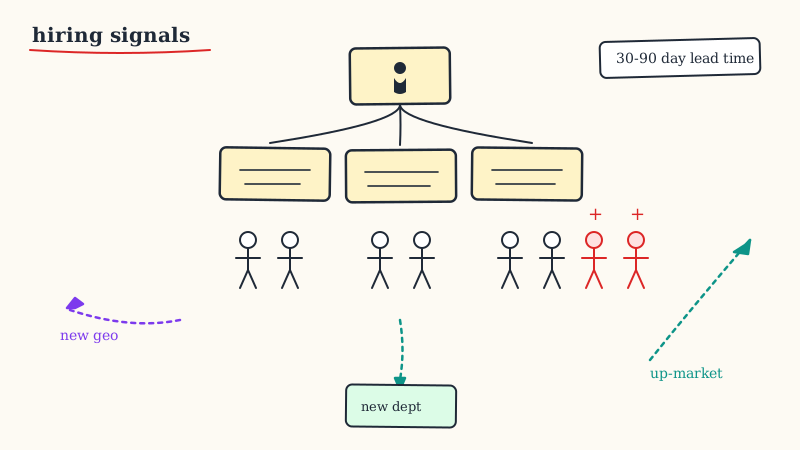
Track Competitor Hiring Patterns to Predict Strategic Shifts Before They Happen
By the time a competitor publishes a press release announcing their move up-market, their new vertical, or their compliance push, the strategic decision was made six months earlier. The funding was approved three months earlier. And the hiring started two months earlier.
That hiring activity is a public document. Every job posting, every new headcount on LinkedIn, every careers-page update is a leak of strategic intent. The competitive intelligence teams that consistently show up early to deals are not better at parsing press releases. They are better at reading job boards.
This is the simplest, most underused signal in competitive intelligence. Competitors will obscure pricing, hide roadmaps, and lawyer-up their marketing copy, but they cannot recruit talent in secret. If they want senior engineers, enterprise AEs, or a Head of Public Sector, they have to advertise.
Why Hiring Signals Lead Press Releases by 30-90 Days
There is a predictable lag between strategic intent and public announcement. Companies decide to enter a new market, then they raise or allocate budget, then they hire the team to execute, then they build, then they announce. Hiring sits in the middle of that chain, and it is the first publicly visible step.
The typical timeline looks like this. A competitor decides in Q1 to chase enterprise. Q2, they post a job for “VP of Enterprise Sales” and three “Enterprise Account Executives.” Q3, they staff up solutions engineering and customer success for that segment. Q4, they announce the new enterprise tier and a flagship logo. By the time their announcement lands, you should have known their plan for nine months.
That window is your strategic head start. You can adjust positioning, brief your sales team, build battlecards, and pre-empt their go-to-market motion before their first enterprise AE has finished onboarding. The same applies to product expansions, geographic moves, and vertical plays. The hires precede the announcement, predictably.
Most teams miss this because hiring data feels like noise. There are too many roles to read, too many companies to track, and the signal is buried in the volume. The fix is not to read more, it is to filter for the patterns that actually matter.
What to Monitor: The Five Hiring Signals That Matter
Not every competitor job posting is a strategic signal. The art is separating the routine backfill from the directional bets.
1. Job Posting Volume by Department
The single most reliable signal is a sudden volume spike in a single department. One new posting is noise. Five postings in security engineering inside thirty days is a strategic bet. Departments to watch:
- Engineering by sub-discipline. Security, ML/AI, infrastructure, mobile, and platform hires each suggest different product directions.
- Sales by segment. Enterprise vs SMB vs mid-market AE hiring tells you which segment they are pushing into.
- Customer success and solutions engineering. These are leading indicators for product complexity and enterprise readiness.
- Compliance, legal, and public sector. These hires almost always precede a regulated-industry play (healthcare, fintech, government).
2. Seniority of New Hires
A Director of Vertical X is louder than five ICs in that vertical. A VP-level hire signals an entire org being built underneath them within twelve months. Track the seniority distribution, not just the volume. When a competitor adds their first VP of Customer Success, they are about to invest heavily in retention, which often correlates with a churn problem you can sell against.
3. Geographic Expansion Patterns
Where they hire matters as much as what they hire for. New job postings in Berlin, London, or Singapore signal regional expansion. Postings that suddenly require fluency in Japanese or German tell you about market entry plans before any press release. A US-only competitor opening a UK sales hub is announcing their European go-to-market three quarters before their website mentions it.
4. Role Titles That Encode Strategy
The exact wording of role titles is one of the highest-signal features. Specific titles to flag immediately:
- “Head of [Vertical]” (Head of Healthcare, Head of Financial Services). New vertical play.
- “Director of Compliance” or “CISO.” Enterprise readiness, regulated industry entry, or response to a security incident.
- “VP of Customer Success.” Retention investment, often signaling churn pressure.
- “Head of Channel” or “Director of Partnerships.” Pivot to indirect sales, which changes their pricing and discounting behavior.
- “Solutions Architect” in volume. Enterprise sales motion, complex deals, longer sales cycles.
- “Product Manager, [New Area].” A net-new product line. This is the loudest possible roadmap leak.
5. Departure Signals via Tenure Data
Hiring is half the picture. Departures matter equally. When a competitor’s senior PM or AE shows a 14-month tenure on LinkedIn and updates to “open to work,” and three peers do the same in the same quarter, you are looking at internal turbulence. Sales-side turnover often shows up in your win rate before you understand why. Track aggregate tenure on LinkedIn for each competitor and watch for drops.
How to Set Up Tracking Without Drowning in Noise
You do not need a full intelligence team to track this. You need three data sources and an alert layer.
LinkedIn job listings. LinkedIn’s company pages expose all open roles. Watch the count, not just the new postings. A competitor going from 12 open roles to 47 in a quarter is doing something. Their employee count and headcount-by-department breakdown are also public.
Public ATS boards. Most B2B SaaS competitors run Greenhouse, Lever, Ashby, or Workable. These boards are usually public and structured, which means they are easy to parse. URLs follow predictable patterns: boards.greenhouse.io/[company], jobs.lever.co/[company]. These give you cleaner data than LinkedIn, including department tags and location filters.
Careers pages. The exact wording of role descriptions, especially the “you will” and “we are looking for” sections, often reveals the actual product and strategic direction. A job description for a Senior Engineer that mentions “experience with HIPAA” tells you about a healthcare push that is not yet in marketing copy.
Departure tracking via LinkedIn. This is the hardest data source to manage manually. You have to track which employees leave, what their tenure was, and where they go next. Doing this for one competitor takes hours per week. Doing it for ten is impossible without automation.
The job here is not to read every posting. It is to detect threshold crossings: department X went from 2 open roles to 8, geo Y had no postings last quarter and has 5 now, three senior engineers left in 60 days. Platforms like CAM automate the hiring intelligence layer specifically, monitoring competitor LinkedIn activity, job posting volume, and headcount changes, and alerting when thresholds are crossed instead of forcing you to scroll through every new req.
Interpreting the Signals: What Each Pattern Actually Means
The volume and titles of new hires fall into recognizable patterns. Once you have seen a few, you can read most competitor moves at a glance.
Pattern: 5+ engineers in security or compliance. Translation: product expansion into regulated industries (fintech, healthcare, public sector) or enterprise tier launch with SOC 2, HIPAA, or FedRAMP work. Action: review your own compliance positioning. If you are SOC 2 Type II already, lead with that in deals where this competitor shows up.
Pattern: 5+ enterprise AEs and a VP of Enterprise Sales. Translation: ICP shift up-market. They are leaving SMB behind, raising prices, and chasing $100K+ ACVs. Action: pre-empt the messaging shift. Their SMB customers are about to be deprioritized, which is the moment to run a targeted outbound campaign to that base.
Pattern: International hiring (specifically EMEA or APAC). Translation: regional expansion, usually following a funding round. Action: check if their pricing supports the region. Many US SaaS companies enter Europe with US pricing, which creates a pricing-sensitive opening if you have a localized offering.
Pattern: Heavy customer success hiring relative to AE hiring. Translation: retention problem. They are not growing the top of funnel, they are trying to plug the bottom. Action: target their existing customer base directly. The competitor monitoring view in CAM makes this kind of CS-heavy signal stand out by tracking the ratio of new hires by function over time.
Pattern: Backfilling churn (senior departures replaced by similar roles). Translation: strategic stagnation. They are running in place. Action: this is a deal-acceleration signal. Their internal momentum is low. Reach out to dormant prospects who were considering them.
Pattern: First “Head of Vertical X” hire. Translation: net-new vertical play, usually 90-180 days from public launch. Action: if vertical X is your strength, increase your outbound in that segment immediately. The 90-day head start is what allows you to land logos before they have a sales motion built.
Pattern: “VP of Channel” or “Director of Partnerships.” Translation: shift to indirect sales. Their economics are about to change, often resulting in higher list prices and aggressive partner margins. Action: prepare your channel-vs-direct talking points for prospects who care about long-term pricing predictability.
Building Sales Talking Points From Hiring Shifts
The point of all this is not a clean intelligence dashboard. It is winning calls. When a prospect mentions a competitor, your AE should be able to translate hiring data into a credible, specific point of view.
The CISO hire. “Yes, we noticed they just hired their first CISO and three security engineers. That is usually a signal that the security review process is about to get longer, not shorter, while they catch up. We have been SOC 2 Type II compliant for two years. Our customers in regulated industries can show you our security posture in their next vendor review without needing to wait six months.”
The enterprise AE wave. “They just expanded their enterprise team from one rep to seven. That is a strong indicator they are pushing up-market. For accounts your size, that usually means longer sales cycles and minimum commits. Our motion is built around mid-market deal velocity, which is why customers like [logo] chose us over them.”
The geographic expansion. “We saw they just opened a UK office and posted four roles in London. They will be onboarding through Q2. If you need a partner with established European customers and a localized data residency story today, that is where the gap is.”
The pattern: ground every talking point in a specific, observable hiring fact, then convert it into an outcome the prospect cares about. Hiring data gives the AE ammunition that does not feel like a sales pitch, because it is verifiable. A prospect can confirm it on LinkedIn in thirty seconds.
False Positives: When Hiring Data Lies
Not every hiring signal is strategic. Three patterns that look loud but are usually noise:
Backfill masquerading as growth. A competitor posting five engineering roles after losing five engineers is not growing, they are running in place. Cross-reference job postings against recent departures. If the inbound and outbound roughly match, treat it as backfill.
Org-chart padding. Some companies, especially post-funding, hire to look impressive rather than to execute. A sudden flood of director-level hires without ICs underneath them often means the leadership layer is being inflated to support a fundraise narrative, not a strategic push. Watch for the IC-to-manager ratio.
Recruiting agency inflation. A large external recruiter contract sometimes produces a burst of postings that gets canceled within sixty days. Track which postings actually get filled (LinkedIn employee count moves) versus which sit open. Postings that linger for 90+ days are usually aspirational, not real bets.
The way to avoid these false positives is to wait for confirmation. A single signal is a hypothesis. Two correlated signals (job postings plus headcount growth plus role-title patterns) is a strategic bet.
Automating the Threshold Detection
Reading every competitor job board weekly is unsustainable. The work that scales is threshold-based alerting: tell me when something crosses a line that matters.
The thresholds worth setting up:
- Department headcount up X% in 30 days
- First-ever hire with title containing “Head of,” “VP of,” or “Chief” in a specific function
- Geographic expansion (first hire in a new country)
- Departure rate above X% of total headcount in 30 days
- Specific keyword triggers in job descriptions (“HIPAA,” “FedRAMP,” “GDPR,” “channel”)
This is exactly the kind of monitoring that does not work as a manual process and works extremely well as an automated one. CAM was built to consolidate competitor LinkedIn signals, hiring patterns, and headcount changes into a single feed, with alerts when thresholds are crossed, so your team gets the strategic signal without scrolling through every individual req.
For teams running outbound campaigns triggered by these hiring signals, the data quality of your prospect lists matters as much as the timing. Reaching out to a competitor’s churning customers when your email list is half-bounced wastes the window. Scrubby handles email validation before sends, so when you have a 30-day strategic head start, it is not wasted on undeliverable contacts.
The Hiring Intelligence Playbook
Ten minutes a week, done consistently, beats ten hours done quarterly. Here is the playbook:
Weekly. Review the alerts. New role titles that match strategic-shift patterns. Department-level volume changes. Geographic firsts. Aggregate tenure shifts.
Monthly. Roll the signals up into a one-page brief per Tier 1 competitor. What changed in their hiring this month, what hypothesis it supports, and what action your team should take.
Quarterly. Compare your hypotheses against actual competitor announcements. The teams that get good at this are the ones that close the loop, score their predictions, and tighten their pattern-matching over time.
The competitive intelligence advantage is no longer about reading competitor blog posts faster than the next person. It is about reading the public artifacts that competitors cannot suppress. Hiring data is the loudest of those artifacts. The teams that listen to it consistently win the deals where strategic context matters, and those tend to be the deals that matter most.
Ready to see competitor activity?
See which accounts your competitors are targeting on LinkedIn before you cold-call them.
Book a Walkthrough