
Monitor a Competitor's Status Page to Turn Their Downtime Into Your Sales Angle
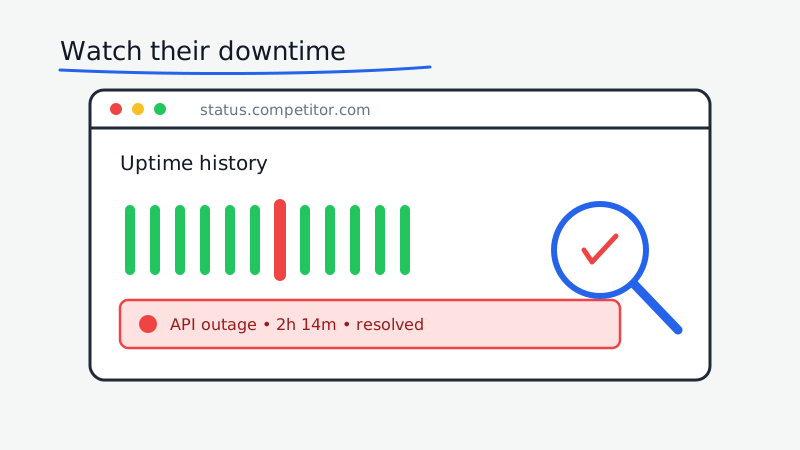
Every serious software company publishes a status page. It is supposed to reassure customers, and most of the time it does. But a status page is also something else: a public, timestamped, self-reported log of every time the product failed. Your competitor is documenting their own outages in the open, and almost nobody on the sales side is reading it.
That is a missed opportunity, because reliability is one of the few competitive claims a buyer takes seriously. Features can be matched and pricing can be negotiated, but a prospect who has been burned by an outage remembers it. If you know a competitor’s outage history in detail, you hold a sales angle that is specific, verifiable, and impossible for them to spin away in the room.
This post is about how to track a competitor’s status page systematically, and how to use what you find without sounding like you are mudslinging.
Why a status page is such a rich signal
A status page tells you far more than “the site was down on Tuesday.” Read over time, the patterns reveal how a company actually operates.
Frequency tells you whether outages are rare accidents or a chronic condition. One incident in a year is noise. One a month is a story.
Duration tells you about their engineering maturity. Short, quickly resolved incidents suggest good observability and on-call discipline. Multi-hour outages suggest the opposite.
Components tell you which parts of the product are fragile. If the “API” or “data sync” component fails repeatedly while the marketing site stays up, you have learned exactly where the product is weak, and which prospects, the technical, integration-dependent ones, should care most.
Timing tells you about their release process. A cluster of incidents right after feature announcements suggests they ship faster than they can stabilize, a pattern worth knowing when a prospect is weighing their roadmap promises.
Postmortems, when published, are a gift. They reveal architecture, team size, and how seriously the company takes reliability, in the company’s own words.
None of this is available in a single visit. It only emerges when you capture the page repeatedly and watch how it changes. That is the difference between checking a status page and monitoring one.
The problem with checking it manually
The obvious approach, bookmark the competitor’s status page and glance at it now and then, fails for the same reason manual competitive intelligence always fails. Outages are short and you will miss most of them. Status history pages often only retain a rolling window, so the record disappears before you look. And no human is going to check five competitors’ status pages every day for a year.
By the time you remember to look, the incident has scrolled off the page and the evidence is gone. Reliability intelligence has to be captured continuously and automatically, or it does not exist when you need it in a deal.
This is exactly the kind of recurring, change-based monitoring that CAM is built for: watching a page for real changes, capturing the incident the moment it posts, and keeping a durable timeline so the history is there when a prospect asks. Instead of hoping you happened to look on the right day, you get an alert when a competitor posts an incident and a permanent record of every one.
How to set up reliability monitoring
The setup is straightforward once you treat it as a monitoring task rather than a manual habit.
Find the real status page. It is usually status.competitor.com or competitor.com/status. Many companies use hosted status providers, which means the page structure is predictable and stable to watch.
Monitor the incident feed, not just the homepage. You want alerts when a new incident is posted and when an existing one updates or resolves, so you can capture both the outage and how long it took to fix.
Filter out the noise. Scheduled maintenance is not an outage and should not trigger a fire drill. Focus alerts on unplanned incidents and degraded-performance events, which are the ones that actually affect customers.
Log everything to a timeline. The value is cumulative. A single incident is an anecdote. Twelve incidents over six months, with durations and affected components, is evidence.
Watch more than one competitor. Reliability comparisons are most powerful when you can say where each option in a deal actually stands, not just point at one rival.
Using the intelligence without mudslinging
Here is the part most teams get wrong. Walking into a meeting and announcing “your other option was down four times last quarter” is aggressive, unprovable on the spot, and makes you look insecure. Reliability intelligence is a scalpel, not a hammer.
Lead with questions, not accusations. “How important is uptime for your team? Have you had issues with reliability on your current tools?” lets the prospect raise the pain themselves. If they do, you are responding to a stated need, not smearing a competitor.
Make it about their use case. If your monitoring shows a competitor’s API component is the one that keeps failing, and your prospect depends heavily on that integration, you can speak precisely to the risk that matters to them, without naming a single incident.
Stay factual and verifiable. If reliability comes up directly, point to public, self-reported data. “Their status page is public, it is worth reviewing the incident history for the components you depend on.” You are not making a claim. You are directing them to the competitor’s own record.
Reinforce your own reliability. The strongest version of this angle is not attacking theirs, it is demonstrating yours. Share your uptime, your incident response process, your postmortem transparency. Reliability intelligence about a competitor is most persuasive as the contrast to a credible claim about yourself.
The bigger picture
A status page is competitive intelligence the competitor publishes for you, refreshed in real time, with timestamps. Most sales teams ignore it because the data is only useful in aggregate and only available if captured continuously. Set up monitoring once and you turn a stream of small public disclosures into a durable, deal-ready understanding of where each competitor is fragile.
Reliability is one of the few areas where a buyer’s fear is concrete and a competitor’s weakness is publicly documented. Monitor the status page, build the timeline, and you will be the only vendor in the room who can speak to it with evidence. For teams that want this woven into a fuller picture, it pairs naturally with the kind of go-to-market intelligence that partners like Vendisys build into their outbound motions.
Ready to see competitor activity?
See which accounts your competitors are targeting on LinkedIn before you cold-call them.
Book a Walkthrough