
Monitor Competitor Reddit and Hacker News Discussions to Catch Product Complaints and Sales Objections
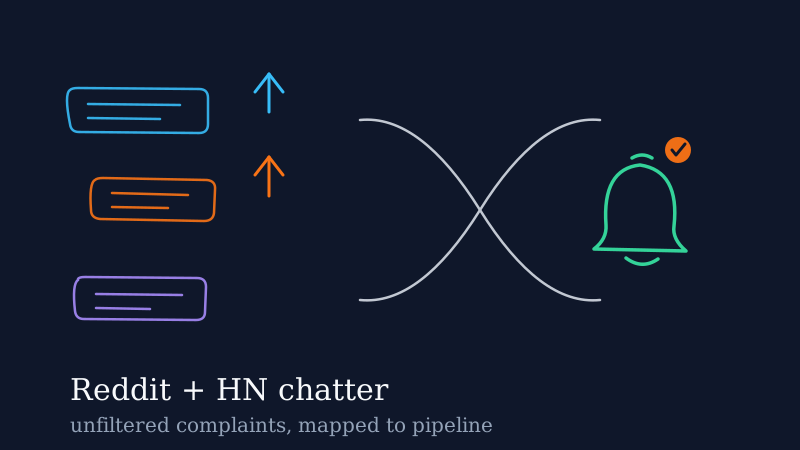
There is a version of your competitor that lives on their marketing site: polished, confident, allegedly beloved. And there is a second version that lives on Reddit and Hacker News, where their actual users complain about the broken feature, the surprise price increase, and the support ticket that has been open for three weeks. The second version is the one that closes deals.
Third-party discussion sites are the least curated intelligence source on the internet. Nobody moderates a subreddit on the vendor’s behalf. Nobody softens a Hacker News comment because it might hurt the roadmap’s feelings. When someone posts “we are migrating off X, here is why,” you are reading a churn story in real time, and often a sales lead with your name on it.
This guide is about the discussions your competitor does not control: Reddit, Hacker News, Stack Overflow, Indie Hackers, and niche industry subforums. It is a different beast from watching a vendor’s own community, which we covered in monitoring competitor forums, Slack, and Discord. Here the vendor has no home-field advantage, so the honesty is turned up to full volume.
Why third-party discussions beat owned channels
A vendor-hosted forum is still the vendor’s house. Threads get pruned, angry posts get “resolved,” and the tone stays inside what the community team can live with. Reddit and Hacker News have none of those guardrails, which is exactly why they are worth monitoring.
Three reasons these channels are uniquely valuable:
-
No moderation bias. On r/SaaS or a Hacker News “Ask HN” thread, the competitor cannot delete a scathing comment. The most upvoted reply is often the most damaging one, and the voting mechanics push the sharpest criticism to the top where you can find it.
-
Buyers gather before they buy. People do not ask “what is the best alternative to X” on the vendor’s own site. They ask it on Reddit. Those threads are pure in-market demand, and every recommendation in the replies is a competitor you are being compared against.
-
Engineers say the quiet part out loud. Hacker News in particular attracts the technical evaluators who will veto a purchase. When a lead engineer writes “we hit the rate limits immediately and the API docs were wrong,” that objection will surface in your next deal too. Better to hear it here first.
The gap between the marketing site and the top Reddit thread is where your positioning should live. It is the same logic behind tracking competitor customer reviews for churn risk: you are listening for the pain that the vendor cannot spin.
What to watch on each platform
Different platforms surface different signal. Point your attention where each one is strongest.
Reddit is the widest net. Watch for:
- “Alternative to [competitor]” threads. These are the highest-intent posts on the platform. Whoever posts is actively shopping, and the replies map the full consideration set.
- Complaint posts that gain traction. A single gripe is noise. A gripe with 200 upvotes and 80 comments is a theme, and usually a theme your product can win on.
- Migration write-ups. “We moved from X to Y after 18 months” posts are gold. They spell out the exact trigger that made a customer leave, which is the trigger you should be selling against.
- Pricing shock. When a competitor changes pricing, the relevant subreddits light up within hours. That reaction tells you how the market actually received the change, which pairs well with tracking the pricing page itself.
Hacker News
Hacker News skews technical and brutally direct. Watch for:
- “Show HN” and launch threads for your competitors, where the top comments are unvarnished product critique from people who tried it in the first hour.
- “Ask HN: what do you use for…” threads that surface which tools engineers actually reach for and which ones they warn each other away from.
- Comment threads on the competitor’s own blog posts when they get submitted, where the community fact-checks the marketing claims in public.
Stack Overflow, Indie Hackers, and niche forums
- Stack Overflow reveals where a product is hard to use. A pile of unanswered questions tagged with a competitor’s SDK is a documented usability gap.
- Indie Hackers and industry-specific subforums carry candid founder and operator takes that never reach the big platforms.
The manual-monitoring trap
Here is what happens the first time a team decides to “keep an eye on Reddit.” Someone bookmarks four subreddits, checks them for a week, gets busy, and stops. Two months later a competitor’s pricing change ignites a 400-comment thread full of your ideal buyers, and nobody on your team sees it until the moment has passed and those buyers have already signed somewhere else.
Manual monitoring fails for structural reasons. The volume is enormous, the signal is buried under memes and off-topic replies, and the posts that matter most are unpredictable: you cannot schedule the day a frustrated customer writes a viral teardown. By the time a human happens to scroll past it, the window to act has usually closed.
The fix is not more discipline. It is to stop checking manually and get alerted only when something on a specific page meaningfully changes.
Building a monitoring system that scales
The practical approach is to monitor the specific URLs where high-intent discussion accumulates and let a tool tell you when they change. This is precisely what CAM was built to do. Instead of refreshing tabs, you point monitors at search-result pages, subreddit feeds, and thread listings, and you get notified when new content appears. An AI judge strips out the formatting churn and vote-count jitter so you only hear about real new discussion, not a reordered feed.
A working setup looks like this:
-
Map the surfaces. For each of your top three to five competitors, collect the URLs worth watching: a Reddit search for the competitor’s name sorted by new, the relevant subreddits, a Hacker News search (via the Algolia HN Search interface, which produces a stable URL per query), and any niche forum threads. Search-result pages are ideal monitor targets because they update whenever a new matching post appears.
-
Monitor each surface as its own alert. Set up a monitor per URL in CAM so a new “alternative to competitor” thread lands as a distinct notification rather than getting lost in a digest. Keep your own brand in one of the queries too, so you catch mentions of yourself in the same sweep.
-
Route alerts to where the team lives. Send notifications into a shared Slack channel or an email alias that both sales and product watch. The goal is that a spike of competitor complaints reaches a rep the same day, not in next quarter’s deck.
-
Theme the incoming signal. Sort alerts into buckets as they arrive: pricing complaints, reliability issues, missing features, and active buyers. Over a few weeks these buckets become a live map of where each competitor is losing trust.
The same monitoring habit that catches a Reddit complaint also catches a quiet status page incident or a changelog edit. Third-party discussion is one more surface in the same intelligence system.
Turning discussions into action
Signal that sits in a Slack channel changes nothing. Here is how each type of discussion becomes a move.
Recurring complaints become objection handling. When the same criticism of a competitor shows up across a dozen threads, hand it to your sales team as a battlecard line. “Their users on Reddit consistently report X” is far more persuasive than a claim you make about yourself. Fold it into your competitor battlecards so reps can quote the pattern.
“Alternative to” threads become outbound targets. These posts are stuffed with in-market buyers. You will not always get a name, but the volume and timing tell your team which competitors are bleeding right now, so you can prioritize outbound against those accounts. When you run that campaign, validate the list first with a tool like Scrubby so your emails actually deliver, and book the resulting demos with calendar-native invites through Kali.
Technical objections become product ammunition. Hacker News critiques of a competitor’s API, limits, or docs preview the objections your own product will face. Feed them to product and pre-empt them in your positioning.
Sentiment trends become win-loss context. A steady rise in negative discussion about a competitor is an early sign you will start winning more head-to-head. Feed that trend into your win-loss program so you can confirm it against real deal outcomes.
A lightweight weekly rhythm
You do not need a dedicated analyst to run this.
- Daily: Skim the automated alerts from CAM. Most days there is little, which is the point. You engage only when a thread moves.
- Weekly: Spend 30 minutes clustering the week’s alerts into themes and flagging anything sales or product should see.
- Monthly: Roll the themes into a one-page summary. Which competitor is drawing more complaints? Which objection keeps recurring? Where is sentiment sliding?
Over a quarter this produces something rare: a documented, evidence-backed record of exactly where each rival is losing their own customers in public.
Start with one competitor and one query
The failure mode is trying to monitor every platform at once and quitting in a week. Do the opposite. Pick your single closest competitor, set up one monitor on a Reddit search for their name, and add one Hacker News query. Within days you will catch your first complaint thread or “alternative to” post, and the value will justify expanding to the next competitor.
Your rivals’ customers are writing the case against them in public every day, on platforms the vendor cannot edit. The only question is whether you are the one reading it first. Set up your first discussion monitor with CAM and turn their worst threads into your pipeline.
Ready to see competitor activity?
See which accounts your competitors are targeting on LinkedIn before you cold-call them.
Book a Walkthrough