
Monitor Competitor Integrations and Partnerships to Read Their Ecosystem Strategy
Monitor Competitor Integrations and Partnerships to Read Their Ecosystem Strategy
Most competitive intelligence work fixates on the loud signals: funding rounds, pricing changes, big hires. Those matter, but they are also the signals everyone else is watching. The quieter tell, and often the more honest one, is the integrations and partnerships page. Every logo a competitor adds there is a deliberate, expensive decision about which ecosystems they want to live inside. Read that page over time and you get something close to their go-to-market roadmap, written in their own words and dated by the day each logo appeared.
The reason this works is simple. Adding an integration is not free. It takes engineering time, a partnership agreement, joint documentation, and usually a co-marketing commitment. Companies do not spend that effort on ecosystems they consider unimportant. So when a new integration shows up, it is a signal that a competitor has decided a particular platform, channel, or buyer is worth chasing. The hard part has never been access to the page. It is noticing the change on the day it happens instead of stumbling onto it a quarter later.
What an integrations page actually reveals
A competitor’s integrations and partners directory is one of the most strategically dense pages they publish, and almost nobody reads it on purpose. Look at it as a time series rather than a snapshot and three patterns emerge.
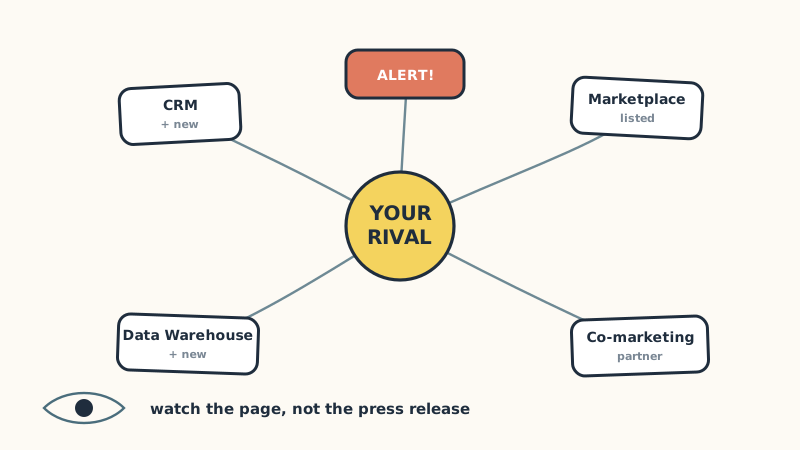
- Which buyer they are courting next. An integration with a CRM points at sales teams. One with a data warehouse points at technical and ops buyers. A sudden cluster of marketing-tool integrations means they are repositioning toward a marketing persona. The category of the integration tells you which department they want to sell into next.
- Where they are betting on distribution. Listing in a marketplace (think the app directories of the big platforms) is a distribution decision, not just a technical one. When a competitor invests in being discoverable inside another product’s ecosystem, they are telling you where they expect their next wave of customers to come from.
- Which partnerships are strategic versus cosmetic. A logo that comes with a joint case study, a co-branded landing page, and a press release is a real alliance. A logo that just appears quietly in a grid is often a checkbox. Watching how a partnership is announced (and how much marketing weight it gets) separates the moves that will reshape the market from the ones that will not.
None of this is hidden. It is sitting on a public page, updated whenever the competitor ships something. The intelligence problem is purely one of attention and timing.
The plays a new integration unlocks
A partnership signal is only worth tracking if it changes what your team does. Three plays consistently pay off when you catch the change early.
1. The displacement sales play
When a competitor announces an integration with a platform your shared prospects already use, two things are true: that platform’s customers are now a hotter target for the competitor, and those same customers just became more reachable for you. The first team to work that overlap wins it. The catch is speed, because the competitor will market into that base while the announcement is fresh.
This is the moment to get a clean, targeted outreach campaign out the door before the window closes. A bounce-heavy send during a competitive push is wasted timing, so run your prospect list through an email validation tool like Scrubby before you scale, then pair it with calendar-based outreach through Kali so “we should reach out” turns into booked demos rather than a backlog. Landing first, while the signal is hot, is the entire point.
2. The partnership counter-move
Ecosystems have limited shelf space. When a rival locks in an integration or a marketplace placement, the partners and platforms adjacent to it are still open, and they will not stay open forever. Seeing the competitor’s move early lets you court the partners they did not reach yet, or deepen the ones you already have before a rival starts writing bigger co-marketing checks for the same relationships. The teams that notice a competitor’s first marketplace listing get to plan their own before it becomes a defensive scramble.
3. The product and positioning read
A pattern of integrations is a roadmap leak. Three new integrations in the same category over two months is not a coincidence, it is a competitor doubling down on a buyer or a use case. That tells your product team where the rival is investing and where they are about to be strong. It also tells your marketing team which positioning the competitor is abandoning, because the ecosystems they stop maintaining are as revealing as the ones they add.
Why this breaks down without monitoring
Every one of these plays depends on catching the change quickly, and that is exactly where manual tracking fails. Integration pages do not announce their own updates. A competitor adds a logo on a random Wednesday, maybe writes a short blog post, maybe does not, and the page quietly looks different than it did the week before. Nobody on your team is assigned to diff a competitor’s partners directory every morning, and even if they were, a single new logo in a grid of forty is easy to miss with the naked eye.
The result is the familiar failure mode. The integration shipped, the displacement window was real, and your team found out a quarter later when a prospect mentioned they were already evaluating the competitor’s new connector. The intelligence was public the entire time. You simply were not watching the page on the day it changed.
This is the gap continuous monitoring is built to close. Instead of relying on someone remembering to check, you track each competitor’s integrations page, partners directory, marketplace listings, and press room, and let the alert come to you when something actually changes. A tool like CAM watches those surfaces continuously and flags a new integration or partnership the day it appears, filtering out the cosmetic page noise so you only hear about real additions. The goal is not to read more pages, it is to never be the last team to learn where a competitor just planted a flag.
A lightweight operating routine
You do not need a dedicated analyst to act on this. A simple routine is enough to turn integration signals into pipeline.
- List the surfaces. For each key competitor, write down their integrations page, partners directory, any marketplace profiles, and their press or news page. These are the four places a partnership shows up.
- Set continuous tracking. Point a monitoring tool at those URLs so a change triggers an alert instead of a calendar reminder you will ignore. Continuous competitor monitoring with CAM removes the manual diffing entirely and only pings you when a logo or partner actually changes.
- Triage on arrival. When an alert fires, ask one question: does this integration touch a buyer, platform, or ecosystem we also sell into? If yes, it is a play. If no, it is context. File it and move on.
- Run the play inside the window. For a relevant addition, move the same week. Pull the overlapping prospect list, validate it, and get outreach out before the competitor’s announcement loses its heat.
The takeaway
A competitor’s integrations and partnerships page is one of the most honest strategy documents they publish, and it updates itself every time they make a real bet. The companies that read it as a live signal, rather than a static page they checked once during a sales-cycle scramble, consistently see ecosystem moves coming. They court the open partners first, they work the displacement window while it is fresh, and they brief their product team on a rival’s direction before it becomes obvious to everyone. The page was always public. The advantage goes to whoever is watching it on the right day.
Ready to see competitor activity?
See which accounts your competitors are targeting on LinkedIn before you cold-call them.
Book a Walkthrough