
How to Monitor Competitor Hiring Patterns to Predict Their Next Product Move
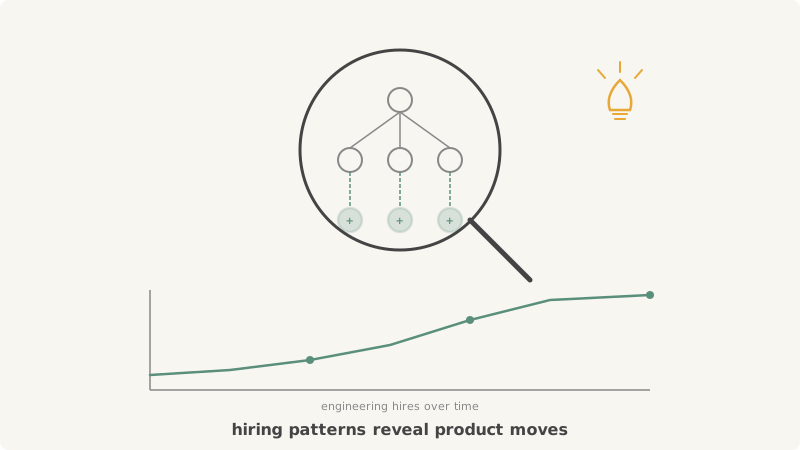
Every product launch starts with a hiring decision. Before a competitor announces a new feature, enters a new market segment, or pivots their positioning, they hire the people to build and sell it. Those hiring signals are public, visible months before the product hits the market, and almost entirely ignored by most competitive intelligence programs.
Job postings are the most undervalued data source in competitive intelligence. They are published openly, updated in real-time, and contain specific technical and strategic details that press releases and blog posts intentionally obscure. A company’s marketing page says “AI-powered analytics.” Their job posting says “Senior ML Engineer, focus on real-time anomaly detection for time-series data in multi-tenant SaaS environments.” One tells you nothing. The other tells you exactly what they are building.
Why Hiring Patterns Are a Leading Indicator
Product development follows a predictable sequence: hire, build, launch. The hiring phase typically begins 3 to 6 months before a product launch, sometimes longer for complex initiatives. This creates a window where the hiring data is publicly visible but the product is not.
There are three categories of hiring signals that matter:
Engineering Hires Reveal Technical Direction
When a competitor posts 5 engineering roles with “Kubernetes” and “multi-region” in the requirements, they are building for scale and global deployment. When they hire ML engineers with NLP specialization, they are adding AI features to their product. When they post for a “Staff Engineer, Billing Platform,” they are overhauling pricing or preparing for usage-based billing.
The specific technologies, frameworks, and focus areas mentioned in engineering job descriptions map directly to what the company is building. A single posting might not be meaningful, but a cluster of 3 to 5 related roles paints a clear picture of their technical roadmap.
Sales and GTM Hires Signal Market Expansion
When a competitor that previously sold to SMB starts hiring enterprise account executives, they are moving upmarket. When they post for a “Regional Sales Director, EMEA,” they are expanding internationally. When they hire a “Partner Manager, SI Channel,” they are building an indirect sales motion.
Sales hiring reveals go-to-market strategy 2 to 4 months before it becomes visible in the market. The roles they hire for tell you which segments they are targeting, which channels they are investing in, and how aggressively they are scaling.
Leadership Hires Reveal Strategic Priorities
A VP of Security hire means compliance and enterprise readiness are becoming priorities. A Chief Revenue Officer hire signals a shift from product-led growth to a sales-led motion. A Head of Data Science hire suggests the company is betting on analytics or AI as a differentiator.
Leadership hires are the strongest signals because they represent significant investment and long-term strategic commitment. Companies do not hire VPs for experiments.
How to Monitor Hiring Systematically
Manual checking of competitor career pages is not sustainable. Career pages update frequently, roles get posted and removed, and the signal-to-noise ratio is low if you are checking 5 to 10 competitors weekly.
Set Up Automated Monitoring
Use CAM to track competitor activity across LinkedIn and career pages. Set up monitoring for each competitor in your space, and configure alerts for new job postings that match specific keywords: engineering roles with relevant technology terms, sales roles that indicate market expansion, and leadership roles that signal strategic shifts.
Automated monitoring turns hiring intelligence from a monthly research project into a continuous stream of actionable signals. When a competitor posts 4 Golang engineer roles in the same week, you know about it the day it happens, not 6 weeks later when someone on your team happens to check their careers page.
Build a Hiring Signal Dashboard
Track the following metrics per competitor, updated weekly:
- Total open roles (trend over time): increasing headcount signals growth investment; freezes signal trouble
- Engineering-to-sales ratio: a company hiring 80% engineers and 20% sales is in build mode. A company at 50/50 is preparing to scale distribution.
- New role categories: roles that did not exist 3 months ago (e.g., first-ever “ML Engineer” posting) indicate new capabilities being built
- Role velocity: how quickly roles are posted and filled. Rapid filling suggests urgency. Roles that stay open for months suggest difficulty hiring or lower priority.
- Geographic expansion: new office locations or remote roles in new regions signal market expansion
Keyword Clustering
Group job postings by technology and domain keywords. If a competitor posts 8 roles in a month and 5 of them mention “GraphQL,” “event-driven architecture,” and “real-time webhooks,” you can infer they are rebuilding their API layer for real-time integrations. That tells your product team something specific about where the competitive product is heading.
Turning Hiring Signals Into Action
Raw hiring data is only useful if it informs decisions. Here is how each team in your company can act on hiring intelligence:
Product Team
If a competitor is hiring ML engineers, your product team needs to decide whether to accelerate your own AI roadmap or double down on a differentiated strength. If they are hiring platform engineers, they may be building an integration ecosystem that you need to monitor.
The key question: “Does this hiring pattern threaten our current positioning, and if so, what is our response?”
Sales Team
Competitor hiring patterns are powerful talking points in competitive deals. If a prospect is evaluating your competitor and you know from hiring data that the competitor is in the middle of a major platform rebuild, you can position that uncertainty: “They are rebuilding their infrastructure right now, which means the product you are seeing today may not be the product you are using in 6 months.”
When your team manages outbound through tools like Kali, build these competitive insights into your calendar invite descriptions and email sequences. A prospect who hears a specific, well-informed competitive point is far more likely to engage than one who hears generic differentiation.
Executive Team
Hiring patterns across the competitive landscape reveal industry-level trends. If three out of five competitors are hiring for “AI” roles simultaneously, the market is moving in that direction and you need a strategy. If competitors are cutting headcount while you are growing, that is a positioning advantage worth communicating to investors, customers, and recruits.
Case Study: Reading a Competitor’s Pivot
Consider a hypothetical scenario. Your competitor, CompetitorX, has historically sold a project management tool to small teams. Over a 3-month window, you observe the following hiring activity:
- Month 1: 2 Senior Backend Engineers (requirements mention “RBAC,” “SOC 2,” “audit logging”)
- Month 1: 1 Product Manager, Enterprise (job description mentions “procurement workflow” and “SSO integration”)
- Month 2: 3 Enterprise Account Executives (job description mentions “$50K+ ACV” and “procurement cycles”)
- Month 2: 1 Solutions Engineer (requirements mention “custom integrations” and “onboarding for 500+ seat deployments”)
- Month 3: 1 VP of Customer Success (job description mentions “enterprise retention” and “expansion revenue”)
The hiring pattern tells a clear story: CompetitorX is moving upmarket. They are building enterprise security features (RBAC, SOC 2, audit logging), hiring enterprise sales (high ACV, procurement), and investing in enterprise customer success. The product launch announcement will come 3 to 6 months after these hires ramp, but you already know what is coming.
Your response: if you also serve the enterprise segment, start reinforcing your enterprise positioning now. If you serve SMB, this is good news because CompetitorX is likely to deprioritize the SMB product as they chase enterprise deals.
Validating Signals Before Acting
Not every hiring signal is meaningful. Companies post roles they never fill. Leadership hires sometimes reflect internal politics rather than strategic shifts. A single job posting in a new technology area might be an experiment, not a commitment.
Validate hiring signals against other data sources:
- Patent filings and technical blog posts: do they align with the engineering roles being posted?
- Press coverage and analyst mentions: are industry analysts pointing to the same strategic direction?
- Product updates and changelog: are recent product changes consistent with the hiring pattern?
- LinkedIn activity and conference talks: are their employees discussing topics related to the new hires?
Use CAM to correlate hiring signals with broader competitor activity. A hiring pattern that aligns with LinkedIn content, product updates, and conference presence is a strong signal. A hiring pattern with no supporting evidence might be noise.
Before acting on competitive intelligence to adjust your outbound strategy, make sure the contacts you are reaching are real and reachable. Validating your email lists with Scrubby ensures that the competitive positioning you have worked to develop actually reaches the prospects who need to hear it.
Building a Competitive Hiring Playbook
Create a recurring monthly process:
- Week 1: Pull updated hiring data from all monitored competitors
- Week 2: Cluster new roles by function and keyword, update the hiring signal dashboard
- Week 3: Distribute a one-page competitive hiring brief to product, sales, and executive teams
- Week 4: Review previous predictions against actual market developments to calibrate accuracy
Over time, you will develop an intuition for which hiring patterns are signal and which are noise. The companies that do this consistently see competitive moves coming 3 to 6 months early, giving them time to respond strategically rather than react after the fact.
Hiring is the most honest signal a company emits. Marketing can be aspirational. Product roadmaps can be speculative. But when a company commits budget to headcount, they are telling you what they actually plan to do. Read those signals, and you will always be one step ahead.
Ready to see competitor activity?
See which accounts your competitors are targeting on LinkedIn before you cold-call them.
Book a Walkthrough