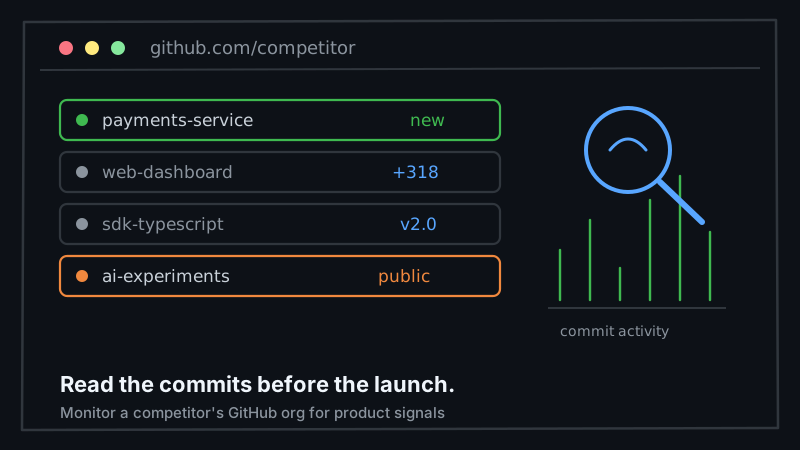
Marketing teams spend weeks trying to figure out what a competitor is about to launch. Meanwhile, the competitor’s engineers are quietly committing the answer to a public repository, complete with timestamps, file names, and README updates that spell out the feature by name.
If your competitor builds developer tools, ships an SDK, or maintains anything open source, their GitHub organization is one of the highest-signal, lowest-noise intelligence sources you have access to. It is public, it updates in real time, and it is written by engineers who are optimizing for clarity to other engineers, not for keeping secrets from you. A new repository, a renamed package, a spike in commits to a branch called billing-v2, these are product decisions made visible weeks or months before a launch page ever goes up.
This post covers exactly what a public GitHub org exposes, the specific signals worth tracking, and how to monitor it continuously so you catch the commit before you catch the press release.
Why GitHub Is Different From Every Other Source
Most competitive intelligence sources describe what a company has already decided to tell you. A changelog shows shipped features. A pricing page shows a finished decision. A press release is polished and timed.
GitHub is upstream of all of that. It shows work in progress. It shows the decision being made, not the decision being announced. That is a fundamentally different vantage point.
A public repo also carries structured, factual detail that marketing pages strip out. You can see the actual name of a new service, the language it is written in, the cloud provider it deploys to, the third-party APIs it integrates, and the pace at which people are working on it. There is very little spin in a package.json file.
And unlike scraping a rendered marketing site, much of GitHub is queryable in a stable, predictable way. Repos, releases, tags, and public activity all have consistent URLs and structure, which makes them ideal to watch for change. This is the same philosophy behind monitoring a competitor’s changelog and docs to detect roadmap shifts, except GitHub sits one step earlier in the pipeline, before the changelog entry is even written.
The Signals Worth Tracking
Not everything in a GitHub org matters. Here are the movements that reliably translate into competitive and product intelligence.
New Repositories Appearing
The single clearest signal is a brand new public repo. When a competitor creates a repository named something like payments-service, mobile-sdk, or ai-agent-runtime, they have just told you the name and shape of an initiative before it has a landing page.
Watch the organization’s repository list itself. A repo that did not exist yesterday and exists today is a near-perfect early indicator of a new product line, a new platform target, or a strategic bet. The name alone often reveals the category.
New Releases, Tags, and Version Jumps
Release pages and version tags are a public promise that something shipped. A jump from v1.9 to v2.0 signals a major change, and the release notes usually explain it in detail the marketing team will only summarize later. Watching the releases page of a competitor’s core SDK or CLI tells you their real shipping cadence, not the cadence they claim in a keynote.
Version numbers also expose velocity. A project that cuts a release every week is being invested in heavily. A project whose last release was fourteen months ago is quietly dying, which is useful to know when a prospect asks how a competitor’s flagship library compares to yours.
Dependency and Tech Stack Changes
The dependency manifests (package.json, go.mod, requirements.txt, Gemfile) are a live readout of a competitor’s technical direction. When a new dependency appears, it tells you what they are building on. Adding a vector database library signals AI or search work. Swapping a payments SDK signals a billing change. Adding a new cloud provider’s SDK signals an infrastructure move.
These are the kinds of quiet stack changes we covered more broadly in monitoring a competitor’s tech stack changes for sales signals. Inside their own repos, the evidence is even more direct than what you can fingerprint from the outside.
Commit and Contributor Activity Spikes
A sudden surge of commits to a repository, or a jump in the number of contributors, means a team has been reassigned to a priority. Even without reading a single line of code, an activity spike on a specific repo tells you where the company is spending its engineering budget right now. Pair that with hiring data and you get a very clear picture. We go deeper on the hiring side in monitoring a competitor’s hiring patterns to predict product moves, and GitHub activity is the confirmation that the roles they hired for are now shipping.
README and Documentation Rewrites
When a competitor rewrites the README of a public repo, changes the tagline, or restructures the docs, they are repositioning the project. A README that used to say “developer tool” and now says “platform” is a strategic shift stated in the project’s own words. These edits are small, easy to miss by hand, and highly meaningful.
Public Issues and Roadmap Discussions
Many open source projects run their roadmap in GitHub Issues, Projects, or Discussions. Pinned issues, milestone pages, and label filters like roadmap or planned expose what the maintainers have committed to next, and the comment threads reveal what their users are frustrated about. This is the developer-audience mirror of what we described in monitoring a competitor’s public roadmap and feature request board for sales signals.
How to Monitor a GitHub Org Without Checking It by Hand
The obvious problem is that nobody has time to open five competitors’ GitHub orgs every morning and diff the repo lists, release pages, and dependency files in their head. GitHub moves constantly, and the meaningful change is usually a single new line buried in a page full of noise.
The answer is to treat the important GitHub pages exactly like any other competitor page you care about: point a change monitoring tool at them and get alerted only when something real changes. This is precisely the job a tool like CAM is built for. You give it the URLs, and it watches for meaningful changes while ignoring the churn that does not matter.
A practical setup looks like this:
- Watch the org’s repositories page. The
github.com/<org>?tab=repositoriesview is your radar for new repos appearing. A good monitor uses an AI judge to ignore star-count jitter and surface the actual structural change: a repo that was not there before. - Watch the releases and tags pages of each core repo. These change only when something ships, so alerts here are almost always signal.
- Watch the key dependency files directly at their raw URLs. When
package.jsonon the main branch changes, you want to know what got added or removed. - Watch the README and roadmap views for repositioning and milestone changes.
- Route alerts by audience. Send new-repo and dependency signals to product and competitive intelligence, and send velocity or repositioning signals to whoever owns your competitive strategy.
The goal is to move from finding out at launch to finding out at commit. Instead of reading a competitor’s announcement and scrambling, you watch the repo appear, watch the releases accumulate, and know what is coming while there is still time to plan a response. When a repo reveals a competitor entering an adjacent space, that early warning is exactly what lets outbound tools like Kali get in front of the accounts most likely to be affected before the competitor does.
Turning GitHub Signals Into Action
Reading the org is only half the value. What you do with the signal is the other half.
For product teams, a new repo or a dependency swap is a prioritization input. If a competitor just started building the exact capability sitting in your backlog, that is a strong argument to move it up, and you now know roughly when it will land based on their commit pace.
For competitive intelligence and sales, GitHub activity makes battlecards concrete. Instead of a vague claim that a competitor “is investing in AI,” you can point to the specific public repo, the date it appeared, and the release history. Factual, timestamped, and drawn from the competitor’s own account. That is far more credible than a generic feature comparison, and it is the same evidentiary approach we recommend across all competitor sources.
For leadership, org-wide GitHub activity is a proxy for where a competitor is placing its bets. A quiet flagship repo next to a fast-moving new one tells a strategic story that no press release will admit to.
The Bottom Line
A public GitHub organization is a competitor narrating their roadmap in real time, in their own words, to an audience of engineers who value precision. New repos name the initiatives. Releases reveal the cadence. Dependency files expose the stack. Commit spikes show where the money is going. All of it is public, and almost all of it lands weeks before the announcement.
The companies that win on competitive timing are not the ones reading launch blogs. They are the ones monitoring the commits. Point a monitor at your competitors’ GitHub orgs, watch the repositories, releases, and dependency files, and let their engineers tell you what is coming next.