
How to Monitor a Competitor's DNS and Domain Changes to Catch Infrastructure Moves Early
Most competitive intelligence looks at what a competitor says: the blog posts, the press releases, the pricing page copy. That is the layer everyone watches, which is exactly why it is late. By the time a company publishes something, the decision behind it was made months ago.
There is a quieter layer underneath the marketing, and almost no one on a sales or product team watches it: the competitor’s DNS records and domain registrations. Every time a company migrates hosting, switches email providers, stands up a new environment, or registers a domain for a product they have not announced, they leave a public, timestamped trail in DNS and WHOIS. Those records change the moment the infrastructure changes, not when the marketing team is ready to talk about it.
This guide is about the plumbing, not the pages. If you want to track brand-new subdomains as a product-launch signal, that is a related but separate discipline (we cover it in our guide on monitoring competitor subdomains). Here we focus on the records themselves: the DNS answers a domain returns, and the domains a company registers.
What DNS and domain records actually reveal
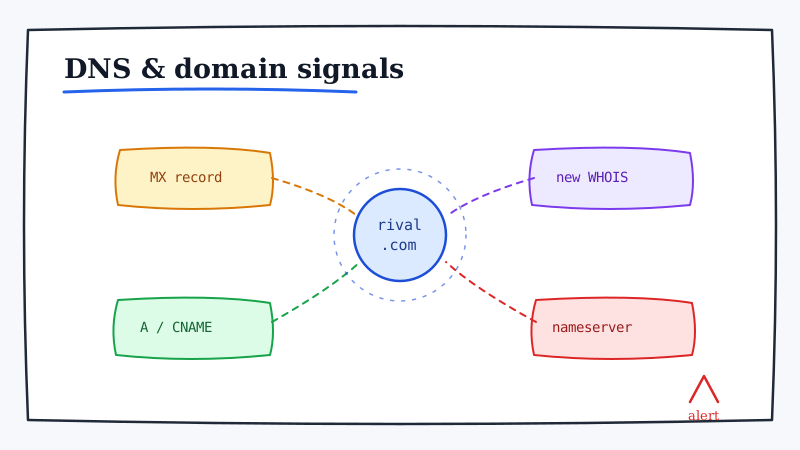
DNS is the public address book of the internet. When you query a competitor’s domain, you get back a set of records that quietly describe how their business runs. Each record type tells a different story.
MX records (email routing). These point to whoever handles the company’s email. A change from Google Workspace to Microsoft 365, or the appearance of a marketing platform like a dedicated sending vendor, tells you the competitor is re-tooling how they communicate and sell. A swap in email infrastructure is often the first visible step of a larger go-to-market change.
A and CNAME records (where the site lives). These map hostnames to servers and services. A move from one cloud provider to another, the sudden appearance of a CDN, or a marketing site pointing at a new website builder all show up here first. When a competitor migrates their main site to a new platform, the A record changes before a single visitor notices.
Nameserver (NS) records. These reveal who runs the DNS itself. A shift in nameservers frequently signals a broader infrastructure overhaul, a new agency relationship, or a security and reliability upgrade. Companies do not change nameservers casually, so a change here is a high-signal event.
TXT records (SPF, DKIM, verification tokens). These are a goldmine. TXT records include verification strings that SaaS vendors ask you to add to prove domain ownership. When a competitor adds a verification token for a new analytics tool, a new CRM, a new support platform, or a new marketing suite, that token often lands in DNS before the tool is live anywhere else. It is one of the cleanest ways to see which vendors a competitor just bought.
WHOIS and new domain registrations. Separate from DNS, the WHOIS system records when a domain was registered and (where not privacy-masked) by whom. A company quietly registering a cluster of related domains (a product name, a campaign name, a set of regional variants) is telling you what they are about to launch, weeks or months ahead.
Individually, any one of these is a data point. Watched together, over time, they form a live map of a competitor’s operational decisions.
Why these signals beat the marketing layer
The reason infrastructure signals are so valuable is timing. Consider the ordering of events when a competitor launches something new:
- Someone registers the domain.
- DNS records are configured and the environment is stood up.
- Vendor verification tokens are added as tools are wired in.
- Internal testing happens on the live infrastructure.
- Marketing, sales enablement, and the press release go out.
Everyone watching the blog and the newsroom reacts at step five. The DNS and WHOIS trail is visible from step one. That gap, often measured in weeks, is the entire opportunity. It is enough time to brief your sales team, prepare a competitive battlecard, adjust positioning, or get ahead of a prospect who is about to be pitched by that competitor.
This is the same logic behind watching any early operational signal, from hiring patterns to funding announcements. Infrastructure just happens to be one of the earliest and hardest to fake.
What each change actually tells you
A raw DNS diff is not intelligence. The skill is in translation. Here is how to read the common changes.
MX record change to a new email vendor. The competitor is likely revamping outbound. If they move onto a serious deliverability or sending stack, expect more aggressive email marketing and cold outreach soon. This is also a moment where their deliverability may temporarily suffer during the cutover, which is worth noting if you compete for the same inboxes. Teams that care about their own sending reputation during moves like this lean on validation tools such as Scrubby to keep their lists clean and their domains healthy while volume ramps.
New CDN or cloud provider on the A record. The competitor is investing in performance, scale, or reliability. This often precedes a bigger traffic push or a product that expects heavier usage. It can also hint at an enterprise motion, since larger customers demand better uptime and lower latency.
A cluster of newly registered domains. This is the strongest launch tell there is. Look at the names. Product-sounding domains suggest a new offering. Geographic variants suggest international expansion. Campaign-sounding domains suggest a big marketing push. Defensive registrations (typos of their own brand) usually mean they are protecting something they are about to promote heavily.
A new SaaS verification token in TXT records. Map the token to the vendor. A new CRM token can mean a sales-process overhaul. A new support-platform token can mean they are scaling customer success. A new analytics token can mean they are getting serious about growth measurement. Each one tells you where they are pouring resources.
Nameserver or registrar change. Often a sign of a security upgrade, a new technical team, or a consolidation after an acquisition. Pair this with any news you have about leadership or funding to confirm the story.
How to monitor DNS and domain changes
You have three broad options, from manual to automated.
Manual spot checks
You can query records yourself. On any machine, dig rival.com MX, dig rival.com TXT, and dig rival.com NS return the current answers. whois rival.com returns registration details. This is fine for a one-time investigation of a single competitor, and it costs nothing.
The problem is that a spot check only tells you the state right now. DNS intelligence is about change over time, and you cannot eyeball a diff you never recorded. Manual checking also does not scale past two or three domains, and it relies on someone remembering to run the commands. In practice, that means the check quietly stops happening after a few weeks.
Scripted snapshots
The next step up is a script that queries the records on a schedule, stores each snapshot, and diffs the latest against the previous one. This works, and for a technical team with time to maintain it, it can be a reasonable starting point.
The hidden cost is maintenance. You have to handle records that legitimately rotate (many services cycle IPs constantly, which creates noise you must filter), deal with rate limits and inconsistent WHOIS formats across registrars, store history somewhere, and build the alerting so a real change reaches a human. Most homegrown scripts start clean and slowly rot into a source of false alarms that everyone learns to ignore.
Automated change monitoring
The most reliable approach is to let a monitoring service watch the records and the relevant pages for you, judge whether a change is meaningful, and alert you only when something real happens. This is exactly the problem CAM is built to solve. Instead of running your own diff pipeline, you point CAM at the competitor properties you care about, and it watches for meaningful change and notifies you, filtering out the routine rotation noise that makes DIY monitoring so painful. It turns a manual, easy-to-forget chore into a standing feed of infrastructure signals across every competitor you track.
The advantage of an automated approach is not just convenience. It is consistency. Competitive intelligence fails most often not because the signal was invisible, but because no one was watching on the day it appeared. A system that never forgets to check is worth more than a smarter analyst who checks sporadically.
Turning a DNS change into an action
A signal is only useful if it ends in a decision. Wire your monitoring so each type of change routes to the right response.
- New product-sounding domains registered. Alert product and competitive intelligence. Start a battlecard draft now, while you have weeks of lead time.
- Email vendor change. Alert marketing and sales. Expect a shift in their outreach, and prepare your counter-messaging.
- New SaaS verification token. Alert competitive intelligence. Update your model of their stack and what it implies about their strategy.
- Hosting or CDN migration. Alert product and sales leadership. This often precedes a scale or enterprise push worth getting ahead of.
For sales specifically, an infrastructure signal is a reason to move. If a competitor is clearly gearing up for a launch or a big push, that is the moment to accelerate deals where you are up against them, before their new narrative lands. When you time outreach to a real event like this, a low-friction channel matters. Teams pairing competitive signals with calendar-based outreach through tools like Kali can get a meeting booked while the signal is still fresh, rather than emailing into the void a month later.
A simple starting playbook
If you want to put this into practice this week, keep it small and concrete:
- Pick your top three to five competitors. Do not try to watch everyone.
- For each, record a baseline today: MX, NS, key A and CNAME records, TXT records, and the list of domains they currently own.
- Set up monitoring on those records and on new domain registrations tied to their brand, using CAM so the checking happens automatically rather than depending on anyone’s memory.
- Define, in advance, who gets alerted for each kind of change and what they do with it.
- Review the feed monthly. Look for patterns across signals, not just isolated events.
The goal is not to drown in DNS trivia. It is to catch the two or three moves a year that actually matter, the migration that signals a scale push, the domain cluster that reveals a launch, the email vendor swap that precedes an outreach blitz, and to catch them while you still have time to do something about it.
The takeaway
A competitor’s marketing tells you what they want you to know, on their schedule. Their DNS records and domain registrations tell you what they are actually doing, on the schedule the work happens. That trail is public, it is timestamped, and it is almost entirely unwatched by the teams that would benefit most from it.
Start with a baseline, automate the watching so it never lapses, and translate each change into a decision. Do that consistently and you will stop learning about competitor moves from their press releases, and start learning about them from the plumbing, weeks earlier, when the information is still worth acting on.
Ready to see competitor activity?
See which accounts your competitors are targeting on LinkedIn before you cold-call them.
Book a Walkthrough