
Monitor Competitor Customer Logos and Case Studies: Detect Enterprise Wins Before Sales Hears Them
Monitor Competitor Customer Logos and Case Studies: Detect Enterprise Wins Before Sales Hears Them
A competitor closes a marquee enterprise deal. Six weeks later, your sales team finds out in the worst possible way: a prospect on a discovery call mentions casually that “actually, we just talked to <Competitor>, and they’re already working with <BigCo>.” The deal cycle changes shape in that sentence. The trust math shifts. The differentiation pitch you walked in with sounds suddenly less convincing.
The information about that enterprise win was sitting in plain sight for six weeks. The competitor put the logo on their homepage two days after contract signature. They updated their “Customers” page within a week. The case study was published 30 days in. Job postings tied to the new account hit the careers page within a fortnight. By the time your team heard about it on a sales call, every other lookalike enterprise prospect had already had the same conversation.
Monitoring competitor customer logos and case studies is one of the highest-leverage and least-systematized competitive intelligence practices in B2B. It signals enterprise wins weeks before they become public knowledge, it identifies lookalike accounts that are statistically more likely to be the next deal, and it gives your sales team the counter-narrative they need to defend every active opportunity in the same vertical.
Why Customer Logo Changes Are an Underrated Signal
Most competitive intelligence programs focus on the loud signals: feature launches, pricing changes, executive hires, funding announcements. Customer logo additions are quieter and more revealing. There are four reasons the signal carries more weight than its volume suggests.
Logo additions are post-contract. A customer logo on a vendor’s website means the deal is closed, paid, and the customer agreed to be referenced. That is much later in the sales cycle than feature announcements (which precede revenue) or job postings (which precede capability). When a logo appears, money has changed hands. The signal is high-confidence.
Enterprise logos signal product fit at scale. When a competitor’s homepage gains a Fortune 1000 logo, the customer almost certainly went through procurement, security review, legal, and pilot phases. That logo signals the competitor’s product clears enterprise procurement bars for that vertical, that company size, and that risk profile. Every prospect that resembles that customer becomes a higher-probability lookalike.
Case studies reveal the use case and ROI claim. Beyond the logo itself, the published case study spells out the use case the competitor sold against, the metrics they claimed, the buying committee involved, and often the displaced incumbent. That is competitive intelligence so detailed that it would otherwise require an analyst firm’s research budget to assemble.
The signal precedes broader market awareness. The customer logo lands on the competitor’s site, the press release goes out 4 to 6 weeks later, the analyst briefings happen 8 to 10 weeks later, the trade press coverage hits 12 weeks later. A sales team monitoring customer logo changes operates 8 to 12 weeks ahead of a sales team that learns from press coverage.
What to Monitor Specifically
The instinct is to monitor “the competitor’s website” as one block. That captures too much noise. The high-signal surfaces are narrower.
Customer logo wall on the homepage. Most B2B vendors maintain a logo wall (“Trusted by”). New additions are signal. Removals are also signal (logo churn often precedes broader account loss, especially if the removed customer is a known reference).
Customers page or dedicated logo grid. A more comprehensive list of named customers, often segmented by vertical, segment, or use case. Additions to specific segments reveal where the competitor is winning right now. A burst of new healthcare customers signals they have product-market fit in that vertical and are likely winning lookalike deals.
Case studies and customer stories page. Each new case study is a deep packet of intelligence. The customer name, the buying committee titles, the problem framing, the alternative solutions considered, the implementation timeline, the ROI claim, the renewal or expansion signal. Read each one as a competitive playbook.
Press release feed and the news section. When a customer win becomes a press release, the language is more polished and the metrics are typically more defensible (legal has reviewed them). Press release additions are confirming signals that the win is significant enough to broadcast.
Customer logo changes in webinar registration pages and resource gates. Some competitors gate webinars and ebooks with “presented by <Customer Logo>” headers. Those logos shift as new customers agree to co-marketing arrangements, and they reveal which customers are deepest into the relationship.
Conference sponsor pages and partner directories. If your competitor’s customer co-presents at a conference, that customer is in deep. Conference programs are public and easy to monitor.
How to Detect Changes in Practice
Manual monitoring scales to about three competitors at weekly cadence before it becomes a part-time job nobody on the team actually does. At any meaningful scale, you need an automated layer.
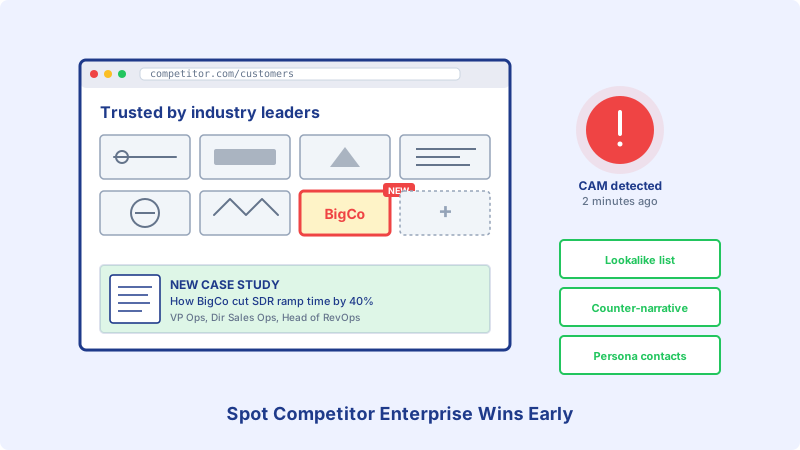
A change-detection tool like CAM can monitor specific URLs on competitor sites, alert on text and image changes, and flag the additions that matter (new logos in the wall, new entries on the customer page, new case studies in the resource section). The configuration takes an afternoon. The alerts arrive in real time, before the change is widely indexed by search engines.
The alert volume from a well-configured competitive monitoring setup is manageable: typically 5 to 15 high-signal changes per week across 10 to 20 competitors, with most arriving via Slack or email. That is small enough that a competitive intelligence lead or a product marketing manager can review each one in under 30 minutes per week and decide which deserve sales team distribution.
The setup that works:
- One page per competitor’s “customers” or “logo wall” location, monitored on a 24-hour cadence
- One page per competitor’s “case studies” or “customer stories” index, monitored on a 24-hour cadence
- A second-tier list of competitor blog posts, webinar pages, and partner pages monitored on a 48-hour cadence
- Alerts routed to a competitive intelligence Slack channel with the diff visible and a tag for which competitor and which page changed
This is essentially the same infrastructure that powers detection of competitor pricing page changes or competitor feature launches, just pointed at a different surface.
What to Do With the Signal
Detecting the change is the easy part. Operationalizing it is where most teams lose the value.
Build a lookalike account list within 48 hours of detection. The new customer logo is a real-world proof point that the competitor wins deals in that profile. Build a list of 20 to 50 companies that resemble the new customer (industry, size, technology stack, geography) and push it into your outbound queue with a campaign tailored to the proof-point. The competitor closed Big Co; the prospect is also a Big Co lookalike; the relevance of your differentiation pitch is suddenly higher.
Build counter-narrative talking points for active deals in the same segment. If your sales team has open opportunities in the same industry, the competitor’s new logo will come up. Build a one-page enabler within 24 hours: who the customer is, why they chose the competitor (read the case study), what your team would have argued, what is true about your differentiation against that specific implementation. Distribute it to AEs covering the segment so the first prospect that mentions the win on a call gets a thoughtful response, not a flat-footed one.
Identify the buying committee titles named in the case study. Case studies routinely name the buying committee (VP of Operations, Director of Sales Ops, Head of Procurement). That is your contact list for the lookalike accounts. The titles that signed off on the competitor’s deal are the titles you want to reach at the next 20 prospects.
Distribute the ROI claim and the alternative-solutions list to product marketing. If the case study claims a specific ROI metric (40 percent reduction in <thing>, 3x increase in <other thing>), that becomes a benchmark you have to address. If the case study names alternative solutions the customer considered, that is the competitive set the customer mapped. Both feed product marketing and your own case study production.
Time outbound campaigns to the announcement cycle. When the case study is published but before the press release lands, you have a 4 to 6 week window where the customer is fresh and proud, the competitor is preparing the broader announcement, and the lookalike market is not yet saturated with the story. Run targeted outbound in that window with calendar invites (using Kali) that reference the segment dynamics specifically. The proof point is fresh; the conversation is timely.
How to Read Case Study Content Like an Analyst
Case studies are marketing collateral, but they leak operational truth if you read them carefully.
The pre-state problem framing. The first third of every case study describes the customer’s pain before the competitor’s solution. That framing is the competitor’s positioning. It is also a reverse-engineered prospect profile: every other company experiencing the same pain is a target for the competitor’s outbound.
The implementation timeline. Case studies often mention how long deployment took (6 weeks, 90 days, one quarter). That is a real number. Compare it to your own implementation timeline. If the competitor is faster, the speed pitch is one of their levers. If you are faster, that is a differentiation point.
The integration list. Case studies name the systems the customer integrated with (Salesforce, HubSpot, Snowflake, custom data lakes). That tells you the technical environment the competitor’s product is winning in. If your product integrates with a different stack, target prospects whose stack matches yours.
The buying committee composition. The titles named in the case study are the buying committee that approved the deal. Cross-reference these against your own deal cycles. If the competitor is winning with VP of Operations as the primary buyer and you are winning with Director of Sales as the primary buyer, the persona-level positioning differs and the targeting strategy should follow.
The metrics claimed. Every metric in a case study has been reviewed by legal, marketing, and sometimes the customer. They are unlikely to be invented, but they are often best-case framings. Take them at 70 to 80 percent of the headline number for realistic benchmarking.
Closing Workflow
For competitive intelligence leads or product marketing managers operationalizing this:
- Identify the 10 to 20 competitors that matter
- Catalog the customer logo wall, customers page, case studies index, and press release feed for each
- Configure automated change detection on each surface (CAM, internal tooling, or manual at low scale)
- Route alerts to a dedicated Slack channel with the diff visible
- Establish a weekly review cadence (30 minutes) for the competitive intelligence lead
- Define the four standard outputs per detected win: lookalike account list, sales counter-narrative, persona contact list, product marketing input
- Track the outbound campaigns that originated from each detected win and measure pipeline contribution
The cumulative effect of running this for two quarters is significant. Sales teams stop being surprised by competitor wins. Outbound campaigns get sharper because the lookalike signals are real. Product marketing builds positioning against actual competitive language rather than theoretical differentiation. The competitive posture shifts from reactive to anticipatory.
The signal was always there. It was just buried in pages that nobody on the team was reading. Move the detection from “manual, occasional” to “automated, immediate” and the rest of the workflow falls into place.
Ready to see competitor activity?
See which accounts your competitors are targeting on LinkedIn before you cold-call them.
Book a Walkthrough