
Identifying Early Sales Cycle Signals Using Competitor LinkedIn Analysis
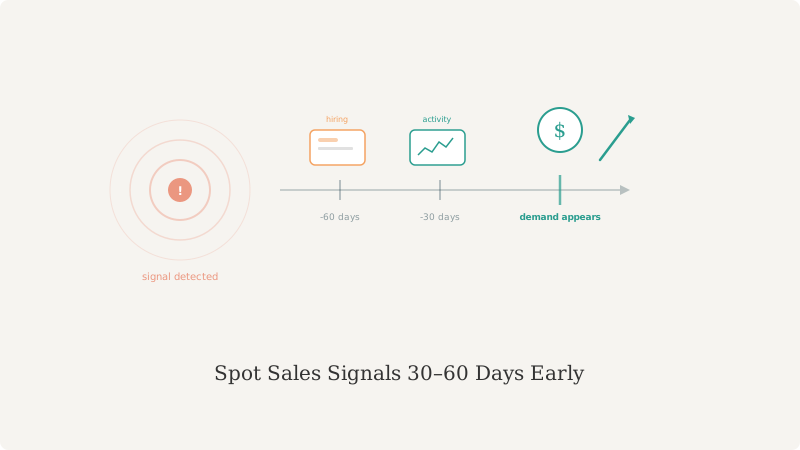
Most sales teams wait for buying signals to come to them.
A prospect downloads a whitepaper. A prospect attends a webinar. A prospect visits the pricing page. These are inbound signals.
But by the time these signals arrive, 5-10 other vendors are already in conversations with the prospect.
The teams that win are those who spot buying signals 30-60 days early.
The best place to find early signals? Your competitors’ LinkedIn activity.
When a competitor announces they’re expanding into a market, hiring for a new territory, or launching a product feature, it signals demand. Markets don’t support multiple vendors launching simultaneously by coincidence. When one vendor expands, it’s because they see opportunity. And when one vendor sees opportunity, others notice fast.
Here’s how to use competitor LinkedIn activity to predict where the next wave of demand is coming from.
The Buying Cycle Signal: Competitors Move First
Phase 1: Market shift (competitors notice first). A new regulation changes compliance requirements. A new technology becomes standard. A new competitor enters a market. Competitors notice this shift immediately (their customers start asking questions). They start hiring. They announce new products. They expand into new regions.
Phase 2: Sales wake-up (30-60 days later). Your sales team notices competitors are hiring or announcing. They get nervous. They wonder what they’re missing.
Phase 3: Customer awareness (60-90 days later). Customers finally realize the shift. They start evaluating new vendors. Now your sales team gets inbound interest.
The problem: by Phase 3, the deal is already half-baked. Other vendors have been talking to the prospect for 30 days. You’re always catching up.
The solution: Monitor competitor activity for Phase 1 signals. Act in Phase 2 (before customers even realize they have a problem).
What Competitor LinkedIn Signals Actually Mean
If competitor is hiring salespeople: Signal: They’re expanding into new markets or segments. Action: Target those exact markets/segments before they saturate.
If competitor is hiring engineers (product team): Signal: New product development is underway. Action: Prospects are probably frustrated with current solutions and considering alternatives. Now is the time to reach them.
If competitor is hiring customer success/support: Signal: Rapid customer growth is happening. Action: Where are the new customers coming from? That’s where you should be prospecting.
If competitor announces a partnership: Signal: They’ve filled a gap in their offering or they’re expanding into a new vertical. Action: Prospects in that vertical now have options. Some will switch. Now is the time to compete.
If competitor announces a price change (usually up): Signal: They’ve built pricing power or the market will bear higher prices. Action: This signals that budget is flowing into your category. It’s not about the price change — it’s about the category getting investment.
If competitor posts about product roadmap or new features: Signal: The feature solves a common customer problem. Action: Prospects are already thinking about this problem. When you call them, lead with that problem (not your feature, their problem).
How to Extract Sales Cycles from Competitor Activity (The System)
Step 1: Track competitor hiring for 12 weeks. Use LinkedIn to monitor competitor job postings every week. Keep a spreadsheet tracking each competitor by week. After 12 weeks, you can see patterns: who’s expanding rapidly (signal = market is hot), into which regions/functions (signal = where demand is highest), when the hiring peaks (signal = 30 days before those markets get competitive).
Step 2: Cross-reference with company announcements. When a competitor is hiring aggressively, check their LinkedIn posts and blog for announcements. Often, hiring follows a strategic announcement by 2-3 weeks.
Timeline example:
- Week 1: Competitor announces “Expanding into Europe”
- Week 3: Job postings appear for European sales team
- Week 5: You should already be in conversations with European prospects
If you wait until week 5 to notice the announcement, you’re 4 weeks too late.
Step 3: Map hiring to your prospect list. Now you know where a competitor is expanding. Map that geography/vertical to your prospect list: “Competitor X just started hiring 5 salespeople in the Midwest. We have 8 prospects in the Midwest. All 8 are now higher-priority because they’ll probably get contacted by Competitor X within 30 days.”
Step 4: Create outreach campaigns based on signals. When you spot a signal, launch a campaign within 7 days: “[Competitor X] just announced they’re expanding into your region. This usually signals they’ve uncovered new demand. We’ve been monitoring this space for 2 years. Here’s what we’re seeing in your market…” This positions you as the analyst, not the vendor. It creates curiosity.
Real Examples of Signals That Predicted Sales Cycles
Example 1: SaaS competitor hires 10 engineers. Signal: They’re building a big product feature. Result: 8 weeks later, they announce a new product category. Action: We reached out to prospects who use our category extensively. “Competitor X is about to launch a competing product. You should evaluate other options before they become established.” Outcome: 3 deals closed from that outreach.
Example 2: Competitor launches in new geography. They post: “Excited to announce we’ve opened an office in Singapore!” They start hiring 4 regional sales reps, 2 customer success. Action: Within 1 week, our team launched a campaign to 20 prospects in Singapore. Outcome: 5 conversations, 2 meetings, 1 deal in progress.
Example 3: Competitor’s VP of Sales moves to a prospect account. You notice a competitor’s VP moved to Company ABC as VP of Sales. Signal: Company ABC is building a sales infrastructure (they’re in growth mode). Action: We called Company ABC’s CEO and CMO. “Congratulations on the VP hire. When new sales leadership comes in, they often evaluate go-to-market tooling. We help teams like yours scale 40% faster.” Outcome: 1 meeting, which led to a $200K deal 6 months later.
Timeline: When to Act on Competitor Signals
The earlier you act, the better your odds.
Announcement day: Competitor announces expansion/hiring/partnership. Your monitoring system flags it. You read it. You take no action yet. Buyer readiness: Too early. They don’t even know they need to change yet.
Week 1: You’ve confirmed the signal (it’s not a one-off post). Action: Your sales team starts 1:1 outreach to related prospects. Buyer readiness: Early. They’re thinking about the market shift.
Week 2: You’ve built a campaign around the signal. Action: You’re reaching 20-50 prospects with a coordinated message. Buyer readiness: Moderate. Some are already talking to competitors.
Week 3-4: First responses are coming in. Action: Your sales team is scheduling demos and discovery calls. Buyer readiness: High. They’re actively evaluating.
Week 5+: Demand is established. Action: You’re competing with 5 other vendors on every deal. Buyer readiness: Maximum, but competition is heavy.
If you wait until Week 5 to start outreach, you’re competing hard. If you started outreach at Week 1, you already have 4 conversations going before competition arrives.
FAQ
Q: How many competitors should I monitor for signals?
Start with 3-5 direct competitors. Add adjacent competitors if you have capacity. Most teams plateau at 10 competitors.
Q: What’s the best source for competitor hiring data?
LinkedIn is best for real-time. Builtwith.com and Crunchbase have historical data. Use both.
Q: Can I predict demand shift by monitoring social media instead of LinkedIn?
LinkedIn is more reliable for business signals. Twitter/X is noise. Use Twitter to monitor what people are talking about, but LinkedIn to identify hiring/partnership signals.
Q: If I see a competitor posting a job, how long until demand shifts?
Usually 4-8 weeks. Sales hiring takes 3-4 weeks to fill. New hires take 2-4 weeks to ramp. Then they start selling. So the signal you see today leads to deals 6-12 weeks from now.
Q: Should my entire sales team monitor competitors or just one person?
One person monitors and extracts high-level signals (weekly digest). That person briefs the sales team. Sales team monitors their own vertical/region for specific prospects.
Q: Can I use this approach in low-competition markets?
If there’s only one other competitor, it’s worth it. If there are zero competitors, you don’t need this system.
Ready to see competitor activity?
See which accounts your competitors are targeting on LinkedIn before you cold-call them.
Book a Walkthrough