
How to Use Competitor Monitoring to Win Renewal Conversations
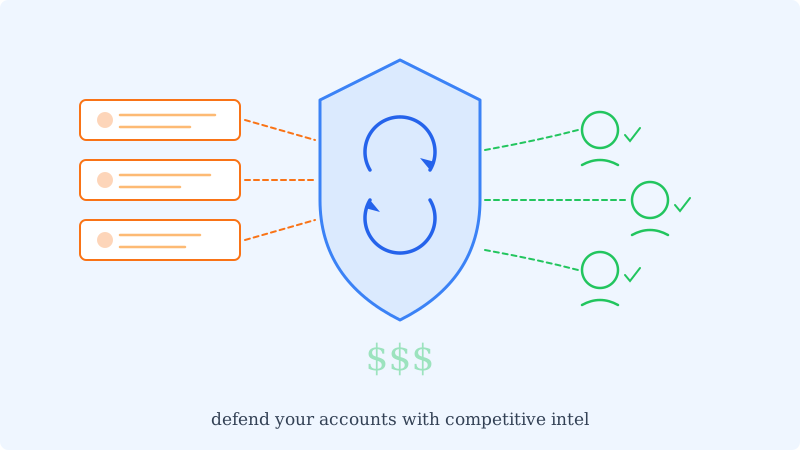
How to Use Competitor Monitoring to Win Renewal Conversations
Your customer’s renewal is 60 days out. The account manager schedules the standard check-in call. Everything seems fine. Usage is steady, the champion is responsive, no support tickets. Then, two weeks before the renewal date, the champion asks to “evaluate some alternatives before committing.” You scramble to pull together competitive positioning, but you are already behind. The competitor has been running targeted campaigns at your customer for months, and you had no idea.
This scenario plays out across SaaS companies every quarter. Competitive intelligence teams spend enormous effort tracking competitors for prospecting purposes (battlecards, win/loss analysis, positioning guides) but rarely apply the same discipline to protecting existing revenue. Retention is where competitive intelligence delivers the highest ROI per dollar spent, because saving a $100K renewal costs far less than acquiring a $100K new customer.
Why Competitors Target Your Existing Customers
Understanding why your customers hear from competitors is the first step in defending against it.
Your customers are the most qualified prospects your competitors can find. They are already paying for software in your category. They have budget allocated. They have the problem your competitors solve. A company that uses your product is, by definition, a proven buyer in the market. Competitors know this, and sophisticated sales teams build prospecting lists specifically from known customers of competing products.
Renewal periods are predictable and targetable. For SaaS products with annual contracts, competitors can estimate renewal windows based on public funding announcements, contract start signals, or simply by targeting accounts on a rolling quarterly basis. Some competitors actively monitor job postings and LinkedIn activity for signals that a company is re-evaluating vendors.
Feature gaps create openings. Every product has limitations. When a competitor launches a feature you do not have, they will aggressively market it to your customer base. If your customer has been requesting that feature through your roadmap and sees a competitor ship it first, the renewal conversation gets significantly harder.
Price increases trigger evaluation cycles. If you raise prices at renewal, even modestly, many customers will use it as an opportunity to run a formal evaluation. Competitors who are monitoring your pricing changes (or who hear from prospects that “we are looking around because of a price increase”) will capitalize on this timing.
Setting Up Competitor Monitoring for Retention
To defend your accounts, you need to know what competitors are doing before your customers tell you. Here is what to monitor and how.
Track Competitor Product Announcements
Every feature launch, integration announcement, and product update from your top three competitors is relevant to retention. When a competitor ships something your customers have been requesting, you need to know immediately so you can proactively address it.
Set up automated monitoring for competitor websites, blogs, and changelog pages. CAM tracks competitor web properties in real time and alerts you when new content is published, pricing pages change, or product features are updated. Instead of manually checking five competitor blogs every week, you get notified the moment something changes. This is the foundation of a proactive retention strategy: knowing what your competitors are saying before your customers relay it to you in a renewal negotiation.
Monitor competitor social media and LinkedIn activity. Competitor marketing teams preview product launches through social channels days or weeks before the official announcement. Tracking their LinkedIn posts and ad campaigns gives you early warning of positioning shifts and new feature messaging. If a competitor starts running ads targeting your product’s category with messaging about a specific pain point, your customer success team needs to know.
Track competitor job postings for strategic signals. When a competitor starts hiring aggressively for roles related to a specific product area (machine learning engineers, compliance specialists, integration developers), it signals where their product is heading. This gives you months of advance notice about competitive threats that will eventually surface in renewal conversations.
Monitor Your Customers’ Engagement With Competitors
Knowing what competitors are doing is half the picture. Knowing whether your customers are paying attention is the other half.
Track if your customer’s employees are engaging with competitor content on LinkedIn. If three people at your customer account start liking or commenting on your competitor’s product launch posts, that is an early churn signal. It does not mean they are leaving, but it means they are aware of alternatives and possibly evaluating them.
Watch for your customer’s employees connecting with competitor sales reps on LinkedIn. This is a stronger signal. When a decision maker at your customer connects with an AE at a competitor, something prompted that connection. It may be networking, or it may be the beginning of an evaluation process.
Monitor review sites for signals. If your customer posts a review on G2 or Capterra that mentions limitations or feature gaps, competitors will see it and use it as prospecting ammunition. You should see it first and address the concern directly.
CAM consolidates these signals into a single dashboard so your customer success and account management teams can act on them without spending hours manually tracking LinkedIn activity and competitor websites.
Track Competitor Pricing and Packaging Changes
Pricing changes from competitors directly impact your renewal leverage.
If a competitor drops their price, expect your customers to mention it. “We saw that [Competitor] now offers a similar product at 30% less” is a renewal objection that catches teams off guard when they are not tracking competitor pricing. If you know the price change happened three months ago, you have time to prepare your value narrative before the renewal conversation.
If a competitor restructures their packaging, it may create favorable comparisons. A competitor might introduce a lower tier that appears to match your product’s features at a lower price point. Understanding the nuances of what is included (and what is not) in their new packaging lets you preempt the comparison rather than react to it.
Track competitor discount patterns. Some competitors offer aggressive switching discounts (50 to 70 percent off the first year) specifically to poach customers from established vendors. If you know a competitor is running a displacement campaign in your market, you can prepare counter-offers and retention strategies in advance.
Turning Competitive Intel Into Renewal Conversations
Monitoring competitors is only valuable if it changes how you engage with customers approaching renewal.
Proactive Outreach Before the Renewal Window
Sixty to ninety days before a renewal, review all competitive intelligence gathered on each account.
Summarize relevant competitor moves. What has each competitor launched, announced, or changed in the past 90 days that is relevant to this customer’s use case? Build a brief (one page maximum) competitive context document for the account team.
Identify potential objections. Based on competitor activity, what questions or comparisons is the customer likely to raise? For each potential objection, prepare a specific response that focuses on your product’s differentiated value, not on attacking the competitor.
Reach out proactively with value, not just a renewal ask. Instead of the standard “your renewal is coming up, let’s schedule a call,” lead with insight. “I noticed [Competitor] launched [feature] recently. I wanted to share how our approach to this problem is different and why our customers have told us it works better for [specific use case].” This positions you as a trusted advisor who is paying attention, not a vendor chasing a signature.
Handling the “We’re Evaluating Alternatives” Conversation
When a customer explicitly tells you they are looking at competitors, competitive monitoring gives you a significant advantage.
You already know which competitors they are likely evaluating. Based on your monitoring, you know which competitors have been active in the customer’s space, who has been advertising to their industry, and which products have recently shipped features that address the customer’s known pain points. You are not guessing. You can address specific competitor strengths and weaknesses with precision.
You can preempt the competitor’s pitch. If you know a competitor is positioning heavily on price, you can lead with your total cost of ownership analysis before the customer brings up pricing. If the competitor is leading with a specific feature, you can proactively demonstrate your equivalent capability or explain your alternative approach.
You can highlight switching costs honestly. Every software switch has hidden costs: migration effort, team retraining, integration rebuilds, and the productivity dip during transition. Quantifying these costs for the customer is not fear-mongering; it is helping them make an informed decision. When you can say “based on what [Competitor] offers, here is what a migration would realistically involve,” backed by specific knowledge of the competitor’s product, your credibility increases dramatically.
Using Competitive Intel for Expansion and Upsell
Competitive monitoring is not just defensive. It creates expansion opportunities.
When a competitor launches a feature your product already has, use it as an upsell trigger. “I saw [Competitor] just announced [capability]. You may not know this, but that is already available in your plan. Want me to show your team how to use it?” This drives adoption of features the customer is already paying for, which increases stickiness and reduces churn risk.
When a competitor raises their prices, highlight your value stability. “While others in the market are increasing prices, we have kept your pricing consistent because we value the partnership.” This is a powerful retention message that reinforces loyalty.
When a competitor exits a market segment or deprioritizes a feature area, use it as a differentiation moment. “I noticed [Competitor] is shifting their focus toward [different market]. We remain fully committed to [customer’s segment] and here is what we are investing in over the next 12 months.”
Building the Retention Intelligence Workflow
Here is a practical workflow for integrating competitive monitoring into your retention process.
Daily: automated monitoring. CAM runs continuous monitoring of competitor websites, social channels, and public activity. Alerts surface automatically when something relevant changes. No manual effort required.
Weekly: CS team review. Customer success managers spend 15 minutes reviewing the week’s competitive alerts and flagging anything relevant to accounts in their portfolio. This replaces ad hoc competitive awareness with structured intelligence.
Monthly: account risk assessment. For every account renewing in the next 90 days, review competitive exposure: which competitors are active in the account’s space, what signals (if any) suggest the customer is evaluating alternatives, and what proactive outreach is warranted.
Quarterly: competitive positioning refresh. Update your internal battlecards and renewal talk tracks based on the last quarter’s competitive intelligence. What new features have competitors shipped? What pricing changes have they made? What is their current messaging strategy? Feed this into your renewal playbooks.
For the outreach component of this workflow, validate your customer contacts before every renewal campaign. People change roles, and the champion who signed the original deal may have a different email address or may have left the company entirely. Run your customer contact list through Scrubby to ensure your renewal outreach actually reaches the right people. And for multi-channel renewal campaigns that combine email, calendar invites, and direct engagement, tools like Kali help you reach decision makers through channels that bypass the crowded inbox.
Stop Playing Defense After the Fact
The difference between companies that retain 95 percent of revenue at renewal and those that retain 80 percent often comes down to timing. Teams that know about competitive threats weeks or months before the renewal conversation can prepare, proactively engage, and position the renewal as a natural continuation of a strong partnership. Teams that learn about competitor evaluations during the renewal call are already behind.
Competitive monitoring for retention is not an additional workload. It is a reallocation of intelligence that most teams are already collecting but only applying to prospecting. Point that same capability at your existing accounts, and you protect the revenue that funds everything else.
Ready to see competitor activity?
See which accounts your competitors are targeting on LinkedIn before you cold-call them.
Book a Walkthrough