
How to Use Competitor Intelligence to Win More Deals in Competitive RFPs
How to Use Competitor Intelligence to Win More Deals in Competitive RFPs
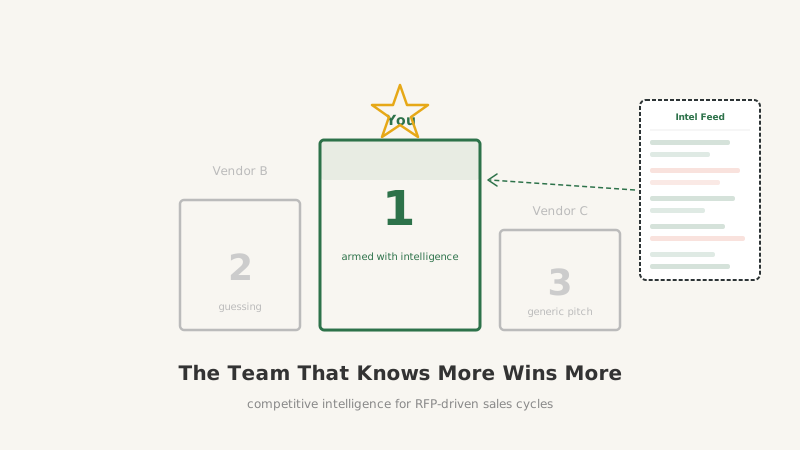
Every enterprise deal with more than one vendor on the shortlist is a competitive deal. The companies that win these deals consistently are not always the ones with the best product. They are the ones that understand their competitors better than the competitors understand themselves.
In RFP-driven sales cycles — common in mid-market and enterprise B2B — the evaluation process is structured. The buyer has criteria. Multiple vendors submit proposals addressing those criteria. Finalists present, demo, and negotiate. The entire process is designed to make an apples-to-apples comparison possible.
The problem for most sales teams is that they treat this process as a product demonstration exercise. They show up, walk through their features, answer questions about their capabilities, and hope the product speaks for itself. Meanwhile, the winning team walks in knowing exactly what the other vendors said in their presentations, what the buyer’s concerns are about each competitor, and how to position their solution as the answer to problems the buyer did not even know they had.
That knowledge gap is the difference between winning 20% of competitive deals and winning 40%.
Why Most Sales Teams Lose Competitive RFPs
The default approach to competitive selling is reactive. A prospect mentions a competitor during a discovery call or RFP process, and the sales team scrambles to pull together a comparison. They check their internal battle cards (if they exist), look at the competitor’s website, maybe scan a recent G2 review, and build a response based on information that is weeks or months stale.
This reactive approach fails for several specific reasons:
Battle cards are outdated by the time they are written. Most sales enablement teams update competitive battle cards quarterly at best. In fast-moving markets, a competitor can launch a new feature, change pricing, acquire a company, or reposition their messaging in the time between battle card updates. Your sales team walks into a competitive deal armed with information from last quarter while the competitor is pitching their latest capabilities.
Public information is table stakes, not an advantage. Every sales team can read a competitor’s website and pricing page. If your competitive intelligence is limited to what is publicly available on the competitor’s marketing site, you have exactly the same information as every other vendor in the RFP. There is no advantage in knowing what everyone else knows.
Competitor messaging shifts signal strategic moves. When a competitor rewrites their homepage headline, launches a new comparison page, or starts targeting a different persona in their content marketing, those changes reflect strategic decisions about positioning, market focus, and differentiation. A sales team that notices these shifts can anticipate competitor pitches and preemptively address them. A team that does not notice is perpetually surprised.
LinkedIn activity reveals priorities and vulnerabilities. What a competitor’s executives and employees post, share, and comment on LinkedIn tells you what they are focused on, what they are proud of, and what concerns them. A competitor whose VP of Engineering is posting about reliability improvements is a competitor that has had reliability problems. A competitor whose SDRs are suddenly posting about a specific use case is a competitor that just launched a play targeting that segment.
Building a Systematic Intelligence Operation
Competitive intelligence for RFP success is not a one-time research project. It is an ongoing operation that feeds fresh insights into every deal cycle. Here is how to build one.
Layer 1: Continuous Competitor Monitoring
The foundation is automated monitoring of competitor activity across multiple channels. You need to know when competitors change their messaging, publish new content, adjust pricing, hire for specific roles, or engage with prospects in your market.
CAM is built for exactly this. It tracks competitor LinkedIn profiles, monitoring what executives and employees post, who engages with their content, and how their messaging evolves over time. This gives you a living intelligence feed rather than a static snapshot.
Set up monitoring for:
- Competitor executive profiles (CEO, VP Sales, VP Marketing, VP Product). Their posts and content shares reveal company-level strategic priorities.
- Competitor SDR and AE profiles. Their outreach messaging and content engagement patterns show what positioning they use in active sales conversations.
- Competitor company pages. Track follower growth, post frequency, and content themes to identify when they are ramping marketing activity in specific segments.
Layer 2: Messaging and Positioning Tracking
Beyond LinkedIn activity, monitor how competitors present themselves across all customer-facing channels.
Website changes. Track their homepage headline, product pages, pricing page, and comparison pages. When a competitor adds a new comparison page mentioning your company by name, you need to know immediately. When they change their pricing structure or add a new tier, that information should reach your sales team the same day.
Content marketing themes. Track the topics competitors are writing about in their blog, publishing as whitepapers, or presenting in webinars. A competitor that publishes three blog posts about a specific integration in one month is betting on that integration as a differentiator. Your sales team should be prepared to address that angle in every competitive deal.
Customer case studies and testimonials. New case studies tell you which customer segments the competitor is winning in, what outcomes they are highlighting, and what proof points they use in sales conversations. If a competitor publishes a case study with a company in your prospect’s industry, your AE will encounter that case study in the RFP process.
Layer 3: Deal-Specific Intelligence
When you enter a specific competitive deal, layer general intelligence with deal-specific research.
Identify the specific competitors in the deal. Ask the prospect directly during discovery. Most buyers will tell you who else they are evaluating, especially in a formal RFP process. If they will not name names, look for signals: did the prospect recently engage with a competitor’s LinkedIn content? Did they attend a competitor’s webinar? Are they following competitor employees?
Research the prospect’s relationship history with each competitor. Check whether the prospect has used the competitor’s product before, whether their employees have connections to competitor employees, and whether the competitor has existing logos in the prospect’s industry vertical.
Tailor your positioning to the specific competitive lineup. Your pitch against Competitor A should be different from your pitch against Competitor B. If you know both are in the deal, address the prospect’s likely concerns about each one specifically rather than delivering a generic presentation.
Turning Intelligence Into RFP Wins
Having competitor intelligence is step one. Using it effectively in the RFP process is where deals are won.
Pre-RFP Positioning
The best time to influence a competitive evaluation is before the formal RFP is issued. If you have an existing relationship with the prospect, share insights that shape their evaluation criteria in your favor.
This does not mean disparaging competitors. It means asking questions that surface requirements where you are strong and competitors are weak. “How important is [specific capability] to your evaluation?” plants a seed. If the competitor does not have that capability, it becomes a gap in their proposal without you having to point it out directly.
In the Written Proposal
RFP responses are typically evaluated by a committee, not just your champion. Committee members who have never spoken to you will read your proposal alongside competitors’. Your proposal needs to differentiate without requiring verbal explanation.
Address competitive alternatives directly. Include a section on “Common approaches and their trade-offs” where you describe architectural or philosophical differences between your approach and alternatives without naming competitors. Evaluators who have seen competitor proposals will recognize the references and appreciate the direct comparison.
Include proof points that counter competitor strengths. If you know a competitor will lead with their speed of implementation, include a case study that demonstrates your implementation speed. If they will lead with breadth of features, include a case study that highlights the depth and reliability of your core offering. Match their anticipated pitch with pre-emptive evidence.
Anticipate and preempt objections. If your intelligence shows that a competitor is likely to raise concerns about your pricing, scalability, or support model, address those concerns proactively in your proposal. A committee member who reads your preemptive answer will view the competitor’s objection as already addressed rather than as a new concern.
In Live Presentations and Demos
This is where real-time competitor intelligence provides the biggest advantage. If you know what the competitor demonstrated yesterday, you can adjust your presentation today.
Lead with differentiation, not features. Do not walk through a feature checklist. Walk through the specific problems that the prospect told you about during discovery and show how your approach differs from alternatives. “Most tools in this space handle [problem] by [competitor’s approach]. Here is why we chose a different path and what that means for your specific situation.”
Use competitive intelligence to ask better questions. During Q&A, ask questions that highlight gaps in the competitor’s offering. “Have you evaluated how [competitor’s typical approach] handles [specific edge case]?” This positions you as knowledgeable and helpful while surfacing competitive weaknesses without being overtly negative.
Be prepared for the competitor’s counterattack. If a competitor knows they are competing against you, they will address your perceived weaknesses in their presentation. Know what those perceived weaknesses are and be ready with updated data, customer references, or architectural explanations that neutralize those talking points.
Measuring Competitive Intelligence ROI
Track these metrics to evaluate whether your intelligence operation is improving win rates:
Competitive win rate. The percentage of deals where at least one named competitor was present that you won. This is the primary metric. Track it monthly and by competitor.
Surprise rate. How often does your sales team encounter competitive information in a deal that they did not already know? A high surprise rate means your intelligence operation has gaps. The goal is zero surprises — your team should know more about the competitor’s pitch than the prospect does.
Time to intelligence. When a competitor makes a significant change (pricing, positioning, product launch), how quickly does that information reach your sales team? If it takes weeks, deals in progress are at risk. If it takes hours, your team can adjust their approach in active deal cycles.
Battle card usage and accuracy. Track whether AEs are actually using competitive materials and whether the information is accurate when they need it. If AEs are ignoring battle cards because the information is stale, you have a freshness problem, not a content problem.
Integrating Intelligence Into Your Outbound Engine
Competitive intelligence does not just improve RFP win rates. It also improves outbound prospecting effectiveness.
When you know a competitor just raised prices, target their customers with messaging about value and cost efficiency. When a competitor has a public outage or negative press, their customers are more receptive to alternatives. When a competitor’s key account executive leaves, their accounts are temporarily under-covered and more open to new conversations.
Use Kali to send timely calendar invites to competitor accounts when trigger events create openings. Validate the email addresses of competitor contacts through Scrubby before any outreach. Have your Underfive AI reply agent ready to respond instantly when those outbound touches generate replies.
If your outbound is managed by Vendisys, feed competitive intelligence directly into targeting criteria and messaging. When your outbound sequences reference specific competitor pain points that the prospect is actually experiencing, reply rates climb significantly.
Knowledge Is the Ultimate Differentiator
In competitive deals, the vendor who knows more wins more. Not always. Not every time. But consistently, over dozens and hundreds of deals, the team with better intelligence has the edge.
Build the monitoring operation. Automate what can be automated. Feed insights to your sales team in real time. And never walk into a competitive deal without knowing exactly what the other side is going to say.
The information is available. The question is whether you are collecting it.
Ready to see competitor activity?
See which accounts your competitors are targeting on LinkedIn before you cold-call them.
Book a Walkthrough