
How to Use Competitor Hiring Signals to Win More Enterprise Deals
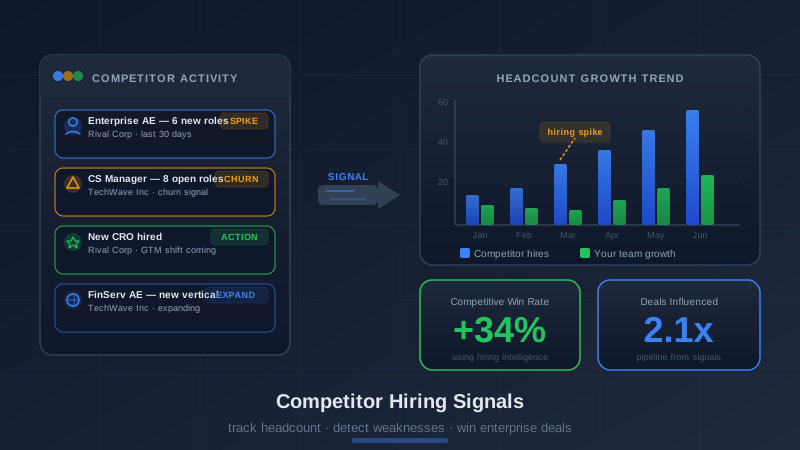
Most enterprise sales teams do competitive intelligence backwards. They wait until a deal is already competitive — until a prospect says “we’re also talking to [Competitor X]” — and then scramble to put together a battlecard.
By that point, you’re playing defense. The competitor has already had multiple conversations with your prospect, shaped the evaluation criteria, and anchored the narrative. Winning from that position is hard.
The teams that consistently win competitive enterprise deals do something different: they watch what competitors are doing before prospects surface them. And one of the most reliable early-warning signals available to any sales team is competitor hiring activity.
Why Hiring Patterns Are High-Signal Intelligence
Job postings are public strategy documents. Every time a company opens a new role, it reveals something about where leadership is allocating budget, which markets they’re entering, which customer segments they’re prioritizing, and — critically — which parts of the organization are under-resourced right now.
For enterprise sales teams, competitor hiring data is valuable in two directions:
It reveals where competitors are doubling down. A competitor hiring ten enterprise account executives in a new vertical is making a bet. That bet takes 6-12 months to pay off. If you can identify that bet early and move into the same vertical before the competitor’s new team is ramped, you can establish relationships before the competition arrives.
It reveals where competitors are stretched thin. A competitor that’s been hiring aggressively for customer success managers for three quarters probably has a churn problem. Their existing customers are struggling, and their team is overwhelmed. That’s a precise, time-bounded window to approach those customers with a better offer.
The challenge is that tracking this manually — checking LinkedIn weekly for a dozen competitors, parsing through job descriptions, making sense of hiring velocity — doesn’t scale. This is exactly what CAM was built to do: surface competitor hiring signals automatically so your sales team can act on them in real time rather than playing catch-up.
Four Hiring Signals That Predict Competitive Activity
Not all job postings carry equal intelligence value. Here are the four patterns that matter most for enterprise sales teams.
1. Sudden Spikes in Enterprise Sales Roles
When a competitor posts five or more enterprise AE, strategic account, or named account roles in a 30-day window, they’re entering a new phase of growth targeting enterprise. This is a signal to:
- Accelerate outreach to enterprise prospects in your shared ICP
- Update your positioning to preemptively differentiate before their new reps get trained
- Reach out to existing customers who might get poached as the competitor expands its coverage model
The hiring spike gives you a 90-day head start before those reps are fully ramped and productive.
2. Customer Success Hiring Waves
A competitor hiring a wave of customer success managers, implementation specialists, or technical account managers usually means one thing: their existing customer base is struggling, and leadership knows it. This is the most actionable hiring signal for competitive displacement.
When you see this pattern, your outreach to their known customers becomes immediately more relevant. You’re not cold-calling — you’re reaching out at a moment when those accounts are most likely to be experiencing friction, evaluating alternatives, or open to a conversation about risk mitigation.
3. New Vertical-Specific Roles
A competitor that posts roles for an “Enterprise Healthcare AE” or a “Financial Services Account Director” is telegraphing a vertical expansion. This is a two-part signal:
- They likely have early traction in that vertical and are doubling down
- They probably don’t have deep coverage yet — the new hire is the beginning, not the end, of their push
If that vertical is already part of your territory, move quickly. If it’s a vertical you’ve been considering, this is data that the market is real and the timing is now.
4. Leadership and Go-to-Market Hires
VP of Sales, Chief Revenue Officer, VP of Marketing, Director of Partnerships hires signal a strategic shift is coming. New GTM leaders almost always reprioritize segments, change positioning, or restructure the sales motion within their first 90-180 days.
This creates a window of internal disruption at the competitor. Their existing sales team is uncertain about the new direction. Their prospects are getting inconsistent messages. Their customers are wondering if the product and support model will change. A competitor in a leadership transition is a competitor at its most vulnerable.
Building a Competitive Hiring Intelligence Playbook
Signals are only valuable if they connect to action. Here’s how to operationalize competitor hiring data into your enterprise sales motion.
Step 1: Define Your Competitor Watch List
Start with five to eight direct competitors — the ones that appear most frequently in deal cycles. Add two or three companies in adjacent categories that are expanding toward your space. This is your primary monitoring list.
For each competitor, identify:
- Which roles signal enterprise expansion (AE, strategic accounts, partnerships)
- Which roles signal customer problems (CS, implementation, support)
- Which geographies or verticals would indicate market overlap with your ICP
CAM tracks competitor LinkedIn activity, connections, and headcount changes so you get the hiring signals without spending an hour per week per competitor doing manual research.
Step 2: Map Hiring Signals to Outreach Triggers
Once you have a watch list, create explicit trigger rules for your sales team. For example:
| Signal | Trigger Action |
|---|---|
| Competitor hires 3+ enterprise AEs | Accelerate outreach to shared ICP accounts |
| Competitor posts 5+ CS roles | Launch competitive displacement sequence to known accounts |
| Competitor hires new CRO | Flag all active deals with that competitor for urgent follow-up |
| Competitor opens new vertical roles | Brief team on vertical positioning; push outreach to that segment |
The trigger rules prevent signals from getting lost. Every rep knows what to do when the signal fires.
Step 3: Use Hiring Data in Sales Conversations
Competitor hiring signals aren’t just for prospecting prioritization — they’re conversation material. Enterprise buyers respect sales reps who demonstrate genuine market knowledge. When you can say, “We’ve noticed [Competitor X] is hiring aggressively for customer success right now — which usually means their existing accounts are experiencing implementation delays. Has that been on your radar?” you’re doing two things:
- Positioning yourself as a credible market observer, not just a vendor pitching features
- Surfacing a concern the buyer may have but hasn’t articulated
This approach works even better when the buyer is already using the competitor. If you can demonstrate that you understand the competitor’s internal pressures better than their own AE has communicated them, you’ve earned trust in a way that no feature comparison sheet can replicate.
Step 4: Time Your Outreach to Competitor Disruption Windows
The 30-90 day window after a major competitor hiring signal is the highest-leverage time for competitive outreach. This is when:
- The competitor’s sales team is distracted by onboarding new colleagues
- The competitor’s customers are uncertain about support coverage during the ramp period
- New leadership is still diagnosing problems rather than solving them
Your outreach during this window lands in a different context than a cold approach in a stable period. The prospect or customer has ambient awareness that the competitor is in a state of change — your timing amplifies the relevance of the conversation you’re starting.
Integrating Hiring Intelligence Into Your Broader Sales Stack
Competitor hiring signals work best when they’re connected to your other sales intelligence sources.
If your team uses Kali for outreach sequencing, you can create competitive displacement sequences that fire automatically when a hiring trigger is detected — pairing the timing intelligence from CAM with the delivery infrastructure of Kali.
For list quality, make sure any contact data you’re sourcing for competitive outreach goes through proper validation. Scrubby handles catch-all email validation, which matters significantly when you’re targeting enterprise accounts where corporate email servers are often configured as catch-all domains. Bouncing off a VP of Operations at a prospect account because the email wasn’t validated properly is an avoidable mistake that undermines an otherwise sharp competitive play.
Across the Vendisys ecosystem, the principle is consistent: better data upstream produces better outcomes downstream. Competitor hiring intelligence is one of the highest-quality upstream signals available to enterprise sales teams — but only if the rest of your stack is clean enough to act on it quickly.
What Good Looks Like
An enterprise sales team that’s properly leveraging competitor hiring signals will have a fundamentally different posture in deal cycles. Instead of reacting to competitive pressure when a prospect mentions a competitor, they’re anticipating it.
They know which competitors are expanding into their territory before the new reps start calling. They know which competitor customers are likely frustrated before those customers go to market for alternatives. They know when a leadership change at a competitor will create a disruption window worth exploiting.
That foreknowledge changes how deals get worked. It changes the timing of outreach, the content of conversations, the urgency that sales leadership allocates to specific accounts. Over a quarter, those adjustments compound into meaningful win-rate improvement on competitive deals.
CAM makes this kind of competitor hiring intelligence operationally sustainable — not a periodic research project, but a continuous signal feed your team acts on in real time.
The Signal Is Already There
Your competitors are publishing their strategic plans every time they post a job. They’re showing you where they’re investing, where they’re stretched, and where they’re vulnerable. The only question is whether your team is reading those signals and acting on them.
Enterprise deals are won by preparation. The sales team with better intelligence — about the market, about the buyer, and about the competition — wins more of them. Competitor hiring signals are among the most accessible and underutilized sources of that intelligence. Start reading them.
Ready to see competitor activity?
See which accounts your competitors are targeting on LinkedIn before you cold-call them.
Book a Walkthrough