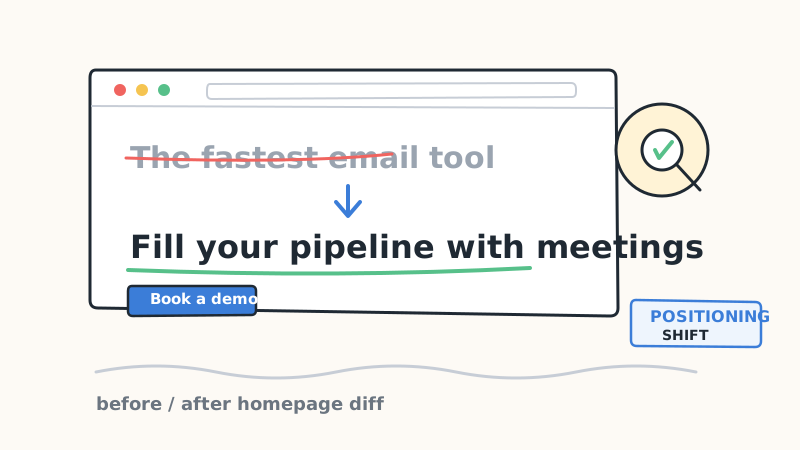
Every competitor spends more time arguing about one sentence than almost any other asset they own: the headline in their homepage hero section. It gets A/B tested, rewritten by new marketing leaders, fought over in positioning workshops, and quietly swapped after a board meeting. That single line of copy is the compressed output of their entire strategy.
Which is exactly why it is worth watching.
When a competitor changes their homepage hero, they are not tweaking a font. They are telling the market who they now want to sell to, what problem they now claim to solve, and which category they now want to compete in. If you catch that change the day it ships instead of the quarter it shows up in a win-loss report, you get a head start on every sales conversation and campaign that follows.
This post explains what to monitor in the hero section, what specific changes actually mean, and how to build a repeatable process that turns homepage rewrites into an early-warning system for your go-to-market team.
Why the Homepage Hero Is the Highest-Signal Copy a Competitor Owns
Most pages on a competitor’s website are stable. Their homepage hero is the opposite. It sits at the intersection of three high-stakes decisions:
- Target buyer. The headline names, or implies, who the product is for. A shift from “for sales teams” to “for revenue operations leaders” is a buyer change, not a wording change.
- Core value proposition. The subheadline usually carries the promise. When “send more email” becomes “book more meetings,” the outcome they sell on has moved up the funnel.
- Category framing. The words a company uses to describe itself decide which competitors they get compared against. “Email tool” and “revenue platform” trigger completely different buying committees.
Because the hero encodes all three at once, a single rewrite can reveal a repositioning that would otherwise take months to surface through sales calls. Teams already watch pricing page changes and navigation menu changes. The hero headline is the connective tissue that explains why those other changes happened.
What Exactly to Monitor in the Hero Section
The hero is more than the big headline. To read positioning correctly, track each of these elements separately, because they move for different reasons:
- The primary headline (H1). The core claim. Changes here are the loudest signal.
- The subheadline. Usually one to two sentences that qualify the promise, name the buyer, or list the outcome. Subtler but often more revealing than the H1.
- The primary call-to-action. “Start free trial” versus “Book a demo” versus “Talk to sales” maps directly to a motion change (product-led versus sales-led).
- Social proof line. The “trusted by” logos or the “join 10,000 teams” stat. Movement here signals a segment shift or a growth claim change.
- The hero visual caption or product framing. Screenshots and captions reveal which feature they now lead with.
You do not need to read all five every day by hand. You need a system that flags when any of them changes, so you only spend attention when there is something to interpret.
How to Decode Common Hero Changes
A change alerts you that something happened. Interpreting it is where the value is. Here are the patterns that come up most often and what they usually mean.
The headline moves up the funnel
A shift from a feature claim to an outcome claim, for example from “The fastest email finder” to “Fill your pipeline with qualified meetings,” almost always means the competitor is trying to sell to a more senior buyer with a bigger budget. Expect their pricing to climb and their sales motion to add a human step. This is your cue to sharpen your own outcome messaging before their new positioning hardens in the market.
The buyer noun changes
When the headline or subheadline swaps the named persona (“for founders” becomes “for go-to-market teams”), they are broadening or repositioning their ICP. A broadened ICP often means they are chasing growth and will show up in more of your deals. A narrowed ICP means they are retreating to a defensible niche, which is an opening for you everywhere else.
The category word changes
“Tool,” “software,” “platform,” and “system” are not interchangeable. When a competitor upgrades their category noun, they are usually preparing to raise prices, launch a second product, or pursue enterprise buyers who do not purchase “tools.” Pair this signal with changes in their navigation menu to confirm whether a new product line is actually behind the reframe.
The CTA changes motion
If “Sign up free” becomes “Request a demo,” they are adding sales-led friction, often to support a move upmarket. If it goes the other way, they are opening a product-led funnel to chase volume and self-serve revenue. Either way, your competitive plays and objection handling need to change to match the buyer they are now courting.
The social proof gets more enterprise
When the logo wall swaps startups for recognizable enterprise brands, or the stat changes from “used by 5,000 people” to “trusted by teams at Fortune 500 companies,” they are staking a claim to a market you may consider yours. This is a defensive alert.
Turning Hero Changes Into Sales and Marketing Action
Detection only pays off if the signal reaches the people who can act on it. Build a simple routing rule for every confirmed hero change:
- Send it to sales enablement. A repositioned competitor means your battlecards are now out of date. Update the “how they describe themselves” line the same week, not the same quarter.
- Send it to demand gen. If a competitor abandons a message, that keyword and angle may open up in paid and organic search. If they double down on one, expect more competition for those terms.
- Send it to product marketing. A category reframe from a serious competitor is a prompt to pressure-test your own category story before their framing becomes the default the market uses.
- Send it to founders and sales leadership. A buyer or motion change from your closest competitor is strategic context for your own roadmap and pricing conversations.
The goal is a short, dated log: what changed, when, our read on why, and who needs to know. Over a few quarters, that log becomes a narrative of your competitor’s strategy that no single win-loss interview could ever reconstruct.
Why Manual Checking Fails and What to Do Instead
The obvious approach is to bookmark a few competitor homepages and eyeball them now and then. This breaks down fast for three reasons. Homepage changes ship without warning, so you will always find out late. Copy changes are easy to miss when you have seen a page fifty times, because your brain fills in what it expects. And the moment you track more than two or three competitors, manual review stops happening at all.
The reliable alternative is automated change monitoring. A tool like CAM watches the exact hero region of a competitor’s homepage and alerts you the moment the headline, subheadline, or CTA changes, with a clean before-and-after diff so you can read the shift in seconds instead of hunting for it. Because it only fires on real content changes, you are not buried under noise from rotating testimonials or tracking parameters. You can point it at every competitor at once and let the signal come to you.
That before-and-after diff is the part that makes homepage monitoring genuinely useful. Seeing the old headline next to the new one is what turns “they changed their site” into “they moved their buyer up-market and dropped the self-serve motion.” The comparison is the intelligence.
Once the competitive alert lands, the follow-up work often runs through your own funnel. If a competitor’s repositioning frees up an audience or a keyword you want to pursue, cleaning your outbound list with Scrubby before you launch keeps your deliverability high, and booking those first conversations with calendar-invite outreach through Kali turns the intelligence into meetings. The point of watching the hero is not to admire the copy. It is to move first.
Start Watching the One Sentence That Explains Everything
A competitor’s homepage headline is the most-considered, most-fought-over sentence they publish. When it changes, their strategy already did. You can either discover that months later in a lost deal, or you can catch it the day it ships and adjust while the change is still fresh.
Pick your top three to five competitors, identify the hero section on each homepage, and put it under continuous monitoring. The first time a rewrite lands in your inbox with a clean diff and you brief your sales team before their next call, you will understand why this one sentence is worth watching more closely than almost anything else your competitors do. Point CAM at those homepages today and let the next positioning shift come find you.